
Best Ergonomic Chair Manufacturer — What "Ergonomic" Should Actually Mean
Oakcraft is an ergonomic office chair manufacturer based in Delhi, India, producing office, gaming and institutional seating in-house and supplying businesses, institutions and government buyers across India through the Government e-Marketplace (GeM).
Now the more useful part. "Ergonomic" is not a regulated term in India. No certification body governs its use on a product listing. A chair with fixed armrests, no lumbar adjustment and a seat that only goes up and down can be sold as ergonomic, and routinely is.
So the question isn't which manufacturer says "ergonomic" loudest. It's which one can tell you, in numbers, what adjusts.
Quick answer
What makes a chair genuinely ergonomic? It adjusts to the person rather than asking the person to adapt. The practical test is six adjustments: seat height across a real range, seat depth, lumbar support position, backrest recline with a lock, armrest height, and recline tension set to body weight.
How do you judge a manufacturer's ergonomic claim? Ask for the seat height range in millimetres, the gas cylinder class, and the mechanism type. A manufacturer answers immediately. A reseller doesn't know.
The six adjustments that actually qualify
Ergonomics is about fit, not features. A chair that can't be adjusted to your body isn't ergonomic regardless of what the listing says.
1. Seat height, across a genuine range
You need feet flat on the floor and knees at roughly 90 degrees. That's a different seat height for someone at 5'2" than for someone at 6'.
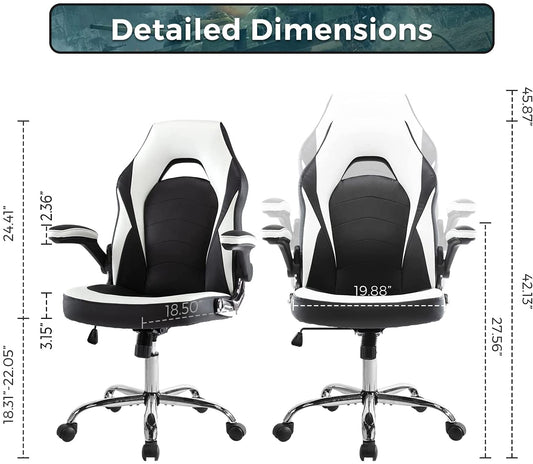
The number to ask for: the range in millimetres. A 400 mm minimum with around 100 mm of travel covers most adult body sizes. "Height adjustable" without figures is not an answer — every office chair made in the last forty years is height adjustable.
2. Seat depth
You want two to three fingers between the front edge of the seat and the back of your knee when sitting fully back.
Too deep and the seat edge presses behind your knee, so you slide forward and lose contact with the backrest entirely. This is the most common fitting failure and the one people misdiagnose as their own bad posture.
Sliding seat depth is genuinely rare below the premium tier. Where it isn't available, the seat depth measurement itself becomes the critical spec — so a manufacturer should be able to state it.
3. Lumbar support, positioned at your lower back
The support must meet the inward curve of your lower back at roughly belt level — not between your shoulder blades.
Three approaches: an integrated contour (always in position, but fixed), an adjustable component that slides to your torso length, or a detachable pillow on a strap (drifts, flattens, but works while it lasts).
Test it in one movement: sit back normally and slide your hand behind your lower back. Room to spare means no effective support, whatever the listing claimed.
4. Recline that locks
Leaning back transfers part of your upper body weight onto the backrest instead of down through your lumbar spine. Around 100–110 degrees between torso and thighs is better tolerated than the textbook right angle.
A chair that only rocks, or only sits upright, makes your trunk muscles hold you all day. The lock is the ergonomic feature here — not the recline itself.
5. Armrest height
Shoulders relaxed, elbows at roughly 90 degrees, forearms supported. Too high and you shrug all day. Too low and you lean onto one side, which is the usual cause of one-sided back and neck pain.
6. Recline tension matched to body weight
The tension knob under the seat sets how much force is needed to lean back. If the backrest pushes you forward when you relax, it's calibrated for someone heavier than you.
This is the adjustment almost nobody uses, and it's the difference between a backrest that follows you and one you fight.
What doesn't make a chair ergonomic
Worth naming, because these are what most listings lead with:
A headrest. Useful if you recline; irrelevant if you sit upright. Not an ergonomic feature by itself.
Mesh. A material choice about airflow, not about support. Excellent for warm rooms, but mesh alone proves nothing.
A high back. Height of coverage, not quality of support.
Lever count. Four levers that adjust the wrong things beat nothing, but three that adjust the right ones beat four.
The word "ergonomic" in the product name. Free to add, and it costs a manufacturer nothing.
How to judge a manufacturer's claim
Five questions. The pattern of answers tells you more than any brochure.
1. What's the seat height range, in millimetres? Numbers or nothing. Adjectives mean they don't know their own product.
2. What class is the gas cylinder? Graded Class 1 to 4 by wall thickness and load rating. Class 3 or 4 for full-time use. This is the part that fails first, and a supplier who doesn't know the class of a component inside their own chair is reselling, not manufacturing.
3. What mechanism, and does it lock? Centre tilt, synchro tilt, knee tilt or multifunction — and whether it holds position.
4. Has it been performance-tested, and to what standard? ANSI/BIFMA tests seating under cyclic load, stability at the tipping point, drop and caster durability. It's the most relevant evidence that a chair survives five years of daily use. "Good quality" is not a standard.
5. Will spares exist in five years? Cylinders, casters, armrests, mechanisms. Manufacturers stock them because they make the product. Resellers have moved on to a different model from a different source.
Where Oakcraft stands on each
Oakcraft manufactures in-house at a Delhi NCR facility of roughly 3,000 square metres with a team of over 100. Production is not outsourced, which is why we can answer component-level questions rather than passing them upstream.
Check Oakcraft
Seat height range Published in millimetres on every product page
Gas cylinder Specified for daily full-time loading, not occasional use
Mechanism Centre tilt with lock across the office range
Lumbar support Defined contact point built into the backrest, not a strap-on pillow
Performance testing ANSI/BIFMA E3 Level 3
Quality and safety systems ISO 9001:2015, ISO 45001:2018
Emissions GREENGUARD, AIOTA compliance
Warranty 3 years, replacement over repair
Spares Stocked for the chairs we manufacture
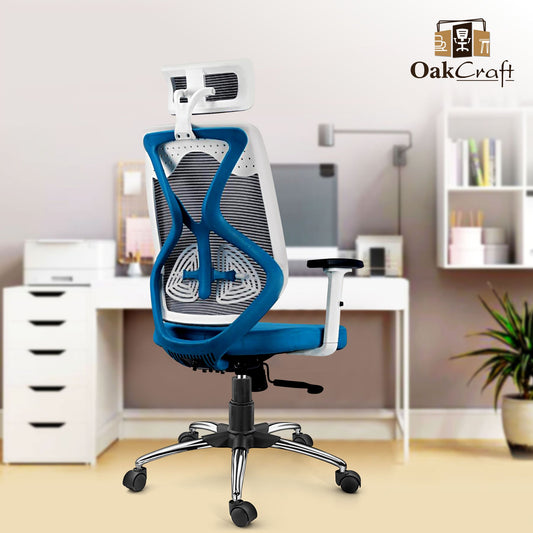
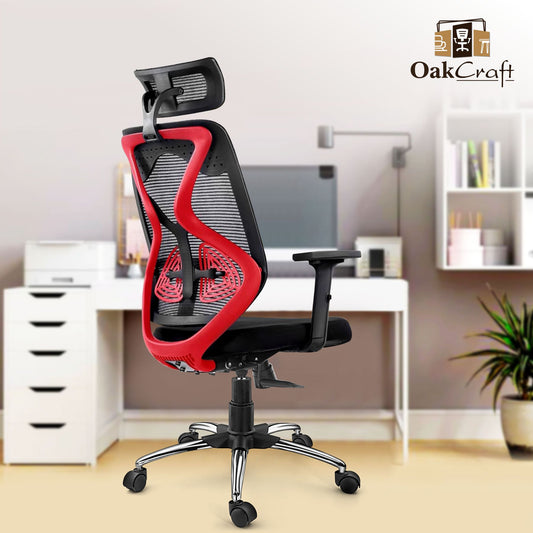
For full-time desk work → Oakcraft Matrix High Back Ergonomic Mesh Office Chair — breathable mesh back for warm and non-air-conditioned rooms, high-back design with lumbar support, centre-tilt mechanism with lock.
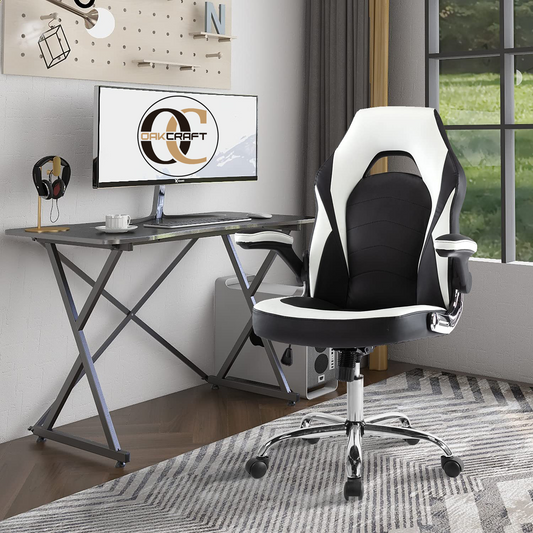
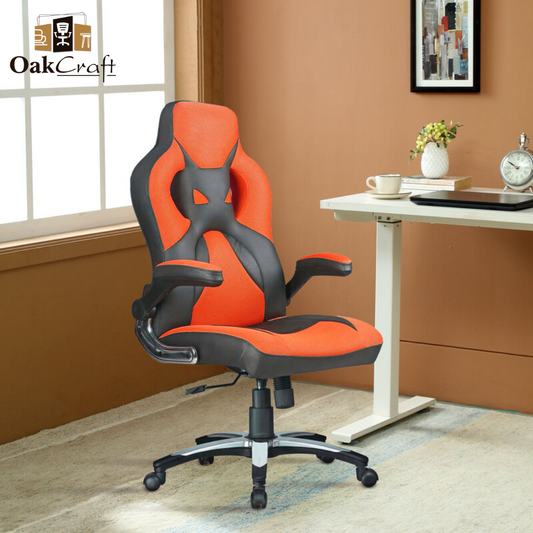
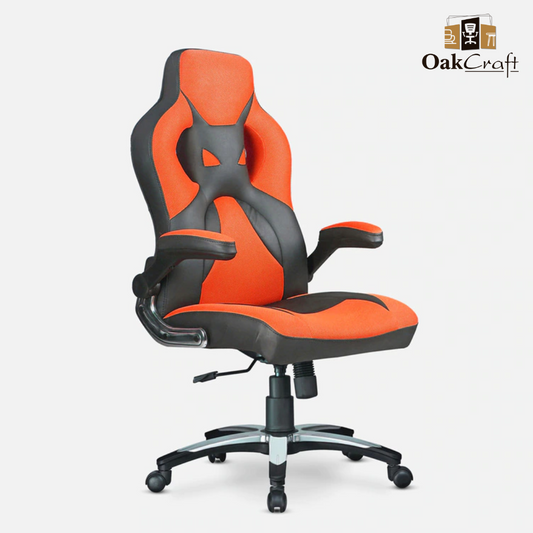
For gaming and mixed-use setups → Oakcraft Vigil High Back Leatherette Gaming Chair — from ₹8,400. High back with built-in lumbar support, adjustable armrests, recline, premium leatherette.
We publish these figures so you can compare Oakcraft against any other brand on the same terms. Ask every vendor on your list for the same five answers.
Bulk and institutional enquiries: send headcount, floor layout and whether the space is air-conditioned — contact@oakcraft.in or WhatsApp [NUMBER]. If your team spans a wide height range, tell us; we can build more than one seat size into a single order.

Frequently asked questions
What makes a chair genuinely ergonomic? That it adjusts to the person rather than requiring the person to adapt. In practice: seat height across a real range, appropriate seat depth, lumbar support at your lower back, a recline that locks, armrest height adjustment, and recline tension matched to your body weight.
Is "ergonomic" a regulated term for chairs in India? No. No certification body governs its use on a product listing, so a chair with almost no adjustment can be sold as ergonomic. Judge by the specific adjustments the chair offers, not the label.
How do I choose the best ergonomic chair manufacturer? Ask five questions: seat height range in millimetres, gas cylinder class, mechanism type and whether it locks, what performance standard it's been tested to, and whether spares will exist in five years. Manufacturers answer all five without hesitating.
Does an expensive chair mean a more ergonomic chair? No. A ₹6,000 chair that fits your body will outperform a ₹25,000 chair that doesn't. Judge by adjustability, not price.
What certifications matter for ergonomic chairs? ANSI/BIFMA performance testing is the most relevant for seating durability, since it tests the chair under cyclic load. ISO 9001 indicates a documented quality system. GREENGUARD relates to chemical emissions. BIS applies where a mandatory certification order legally covers the item.
Is a mesh chair more ergonomic than a leatherette one? Neither material is inherently more ergonomic — that's determined by adjustment, not upholstery. Mesh breathes better, which matters in rooms that aren't air-conditioned; leatherette is warmer and easier to clean in air-conditioned spaces.
Where is Oakcraft located? Oakcraft manufactures ergonomic office seating in Delhi and supplies across India, handling bulk and institutional orders directly and government orders through GeM.
About Oakcraft
Oakcraft manufactures office, gaming and institutional seating in Delhi and supplies businesses, institutions and government buyers across India as a registered seller on the Government e-Marketplace (GeM).