
Gaming Chair vs Office Chair — Which One Should You Actually Buy?
Let's start with something the rest of the internet won't tell you: there is no peer-reviewed clinical trial comparing gaming chairs to office chairs. Not one. Every confident verdict you'll read — including this one — is reasoning from design intent and component specification, not from evidence that one category measurably outperforms the other.
What we do have is a clear picture of where each design came from and what problem it was built to solve. They weren't the same problem. That's enough to give you a useful answer.
We manufacture both categories, which means we have no reason to talk you out of either. Here's the actual comparison.
The 30-second answer
Buy a gaming chair if: you want the racing-seat look, you sit in mixed sessions rather than eight unbroken hours, you're in the ₹8,000–15,000 range where gaming chairs are unusually well-equipped for the money, and your room is air-conditioned.
Buy an office chair if: you work full-time at the desk, you're in a hot or humid room without AC, you're outside the average body size range in either direction, or you already have back pain.
Buy either if it's under three hours a day. At that duration the differences mostly stop mattering.
Different origins, different priorities
Office chairs descend from ergonomics research. The category exists because occupational health people spent decades studying what happens to a body sat at a desk for 2,000 hours a year. Every mainstream feature — adjustable lumbar, seat depth adjustment, tilt tension, armrest adjustment in multiple planes — exists to solve a documented problem.
Gaming chairs descend from racing bucket seats. They emerged in the mid-2000s, modelled on car seats designed to hold a driver in place through lateral G-force. That's the design brief they inherited: contain the body, look fast.
Neither origin is disqualifying. But it explains every difference below.
The seven differences that actually matter
1. Bucket seat vs waterfall edge
Gaming chairs have raised side bolsters and a flat or slightly dished seat pan. Office chairs typically have a waterfall front edge — the seat curves down at the front to reduce pressure behind your knees.
The bolsters are inherited aesthetics, not ergonomics. In practice they can press on your outer thighs and restrict the small position shifts your body makes naturally through a long day. If you're broader than average, they press harder.
2. Seat depth adjustment
Office chairs at mid-range and above frequently offer it. Gaming chairs almost never do — the moulded bucket construction makes it difficult.
This matters because seat depth is the fit dimension most people get wrong. You want two to three fingers between the seat's front edge and the back of your knee. Too deep and you slide forward to escape the pressure, which takes your back off the backrest entirely. With no adjustment, you're relying on the manufacturer's leg-length assumption matching yours.
3. Lumbar pillow vs built-in support
This is the single biggest functional difference.
Most gaming chairs give you a detachable lumbar pillow on a strap. Most office chairs give you integrated lumbar support, often adjustable in height and sometimes depth.
Pillows do work — research on external lumbar cushions shows they help maintain a neutral spine. The problems are practical: they slide out of position through the day, they compress and flatten over months, and they're one shape for every spine. The strap-adjustable ones are meaningfully better than the ones that just sit there.
An integrated contour at the right height, by contrast, is where it is every morning without you thinking about it.
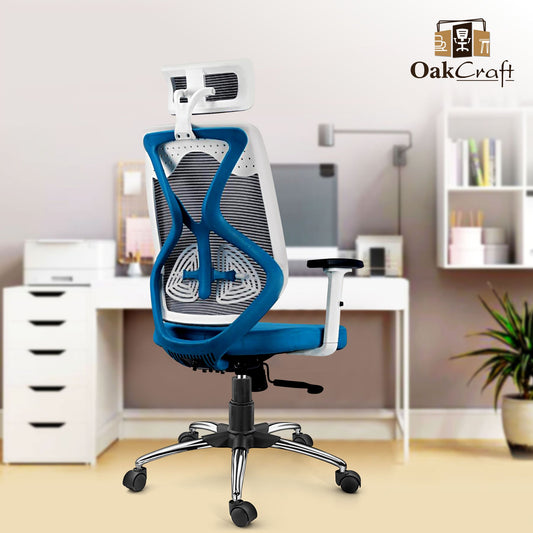
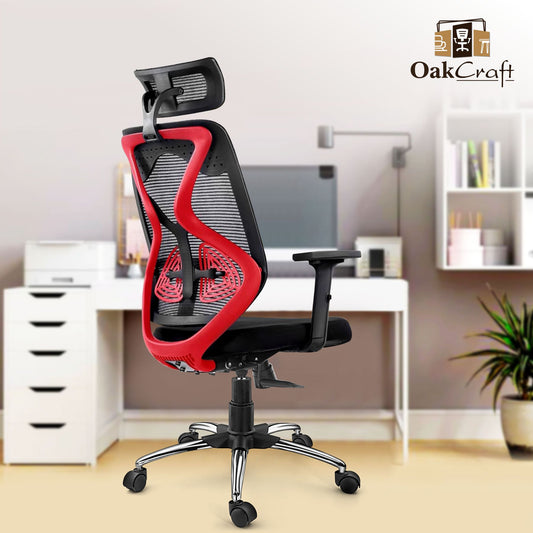
Where we land on this: the Matrix High Back Ergonomic Mesh Office Chair uses cushioned lumbar support built into the backrest at a defined contact point rather than a strap-on pillow — nothing to reposition, nothing to lose behind the desk.
4. Material — and this is the India-specific one
Gaming chairs are overwhelmingly PU leather or fabric-over-foam. Office chairs are commonly mesh.
In an Indian summer, this is not a minor preference. Leatherette doesn't breathe the way mesh does. In a non-air-conditioned room through a Delhi May, that's a real difference over a long session — and it's the consideration most global comparison articles skip entirely, because they're written for temperate climates.
That doesn't make leatherette the wrong choice; it makes it a choice with a condition attached. In an air-conditioned room it's the more comfortable material by some distance — warmer in winter, softer against the body, and far easier to clean than fabric or mesh, which matters more than people expect if you eat at your desk. Quality is what determines whether it lasts: cheap PU cracks and peels at the seat edges and armrest tops within two or three years, while properly specified leatherette over good foam doesn't.
The practical rule: air-conditioned room, leatherette is fine and probably nicer. Non-air-conditioned room where you sit all day, choose a mesh back.
Both, in our range: the Vigil High Back Leatherette Gaming Chair (from ₹8,400) is built on premium leatherette for AC rooms and gaming setups; the Matrix High Back Ergonomic Mesh Office Chair uses a breathable mesh back for long days in a warm room. We manufacture both in Delhi, for Indian conditions — tell us which room it's going in and we'll tell you which one to buy.
5. Recline range
Gaming chairs win here, and it's a genuine advantage. Many recline to 150–180 degrees — effectively flat. If you take breaks at your desk, that's useful in a way no office chair matches.
Office chairs typically offer a smaller range, but with finer control: adjustable tilt tension so the backrest resists at a weight suited to you, and a lock so you can hold an open working angle of around 100–110 degrees.
The question is what you want recline for. Reclining fully between sessions, gaming chair. Holding a comfortable working angle for six hours, office chair.
Both, in our range: the Vigil High Back Leatherette Gaming Chair gives you the deep recline for breaks between sessions; the Matrix High Back Ergonomic Mesh Office Chair uses a centre-tilt mechanism that locks, so you can set an open working angle and stay there all day.
6. Armrests
Roughly even, and it depends on price. Budget gaming chairs often ship with 2D or 3D armrests where an equivalently priced office chair has fixed ones. Above about ₹10,000, office chairs generally pull ahead on the fine adjustment that actually matters — being able to set height so your shoulders stay relaxed and elbows sit at 90 degrees.
7. Body size range
Office chairs are designed against percentile data, aiming to fit most of the population. Gaming chairs are designed against a form factor — and that form factor assumes a fairly specific frame.
If you're notably tall, short, broad or light, an office chair is more likely to fit you. Gaming chairs do come in sizes, but the range is narrower and the bolsters are unforgiving at the edges.
Where gaming chairs genuinely win
It's worth being fair here, because the ergonomics crowd tends to dismiss the whole category.
At the ₹8,000–15,000 mark, gaming chairs are often better equipped than office chairs at the same price. A gaming chair in that band typically has a high back with headrest, a lumbar pillow, 3D armrests and a deep recline. An office chair at ₹10,000 may have none of those. Pound for pound, budget gaming chairs punch above their weight.
The advantage narrows and then reverses above about ₹20,000, where office chairs get seat depth adjustment, dynamic lumbar systems and materials that aren't constrained by having to look like a car seat.
They also win on the thing nobody wants to say out loud: if you like how it looks, you'll use it properly. A chair you enjoy sitting in is not a trivial factor.
Which should you buy? Five real cases
Working from home, 8 hours a day, no AC. Office chair, breathable back. The heat factor decides it. → Matrix High Back Ergonomic Mesh Office Chair
Gaming 3–4 hours in the evening, air-conditioned room. Gaming chair. Deep recline is genuinely useful, the duration doesn't stress the fit compromises, and you'll like looking at it. → Vigil High Back Leatherette Gaming Chair
Both — work all day, game at night, one chair. Office chair with a headrest. It's the one that has to survive the eight hours; the four hours will be fine. → Matrix High Back Ergonomic Mesh Office Chair, which ships with a cushioned headrest as standard
You already have back pain. Office chair with proper lumbar support. You need it at your height, not at the height a pillow happens to sit. → Matrix High Back Ergonomic Mesh Office Chair
Buying for a team. Office chairs, without hesitation. You're fitting many different bodies, and gaming chairs' narrower size range means a portion of your staff won't fit theirs. → Talk to us about bulk pricing — we manufacture, so we can build to your specification rather than a catalogue default
What both should have, regardless of category
The label matters less than the specification. Whichever you buy, check for:
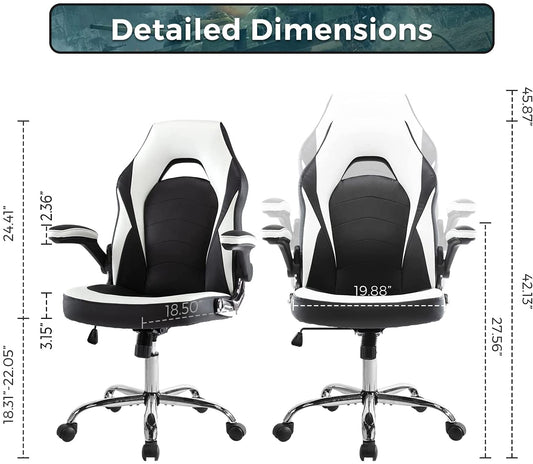
- Seat height range — a 400 mm minimum with around 100 mm of travel is what accommodates different body sizes
- Gas lift class stated — Class 3 or 4 for full-time use; if the seller can't tell you, assume the worst
- Lumbar support at your belt level, whether by pillow, strap or integrated contour
- A recline that locks, so you can hold an angle rather than just rock
- Weight capacity in kg, stated
- Foam that recovers — the difference between a chair that's comfortable in year three and one that isn't
A gaming chair with these beats an office chair without them, every time. That's the actual answer underneath the category debate.
Oakcraft makes both
We manufacture office seating and gaming seating in Delhi, so we'll tell you honestly which one fits your use rather than steering you toward whichever we'd rather sell.
For full-time desk work → Oakcraft Matrix High Back Ergonomic Mesh Office Chair — breathable mesh back, high-back design with lumbar support, centre-tilt mechanism with lock. The one to buy if the room isn't air-conditioned.
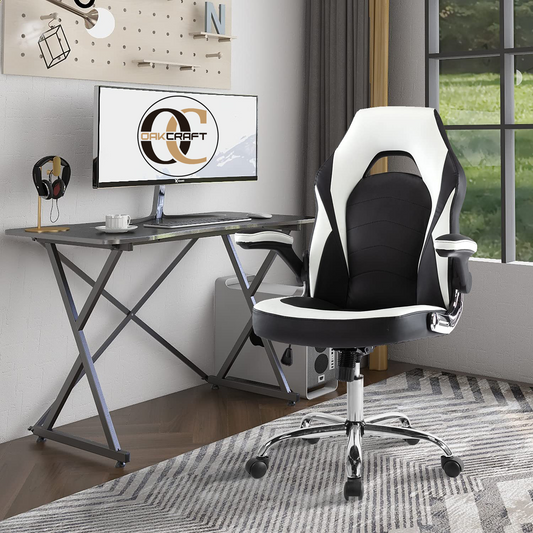
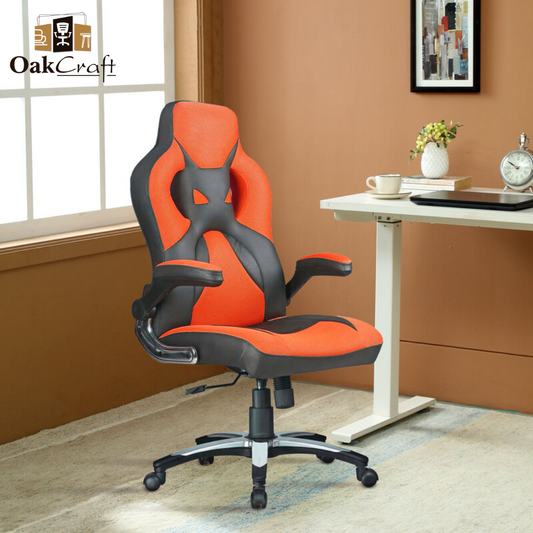
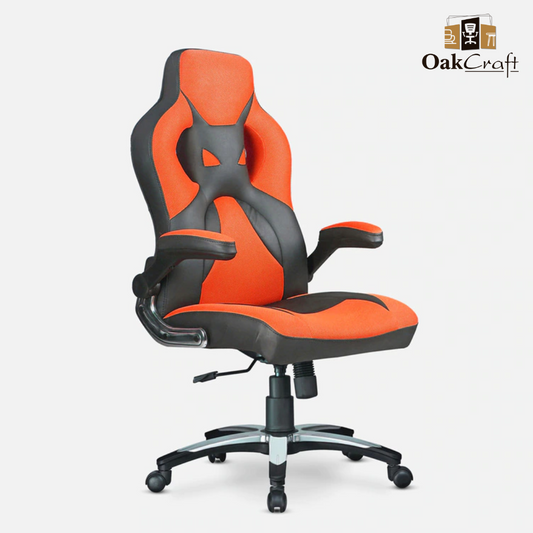
For gaming and mixed use → Oakcraft Vigil High Back Leatherette Gaming Chair — from ₹8,400. High-back silhouette with built-in lumbar support, adjustable armrests, recline, premium leatherette upholstery, sturdy frame and smooth-rolling casters.
[IMAGE: the two models side by side — office and gaming — same angle, same lighting. This comparison shot is the most useful image on the page.]
Not sure which? Tell us your hours, your room and whether it's air-conditioned, and we'll tell you which one to buy — contact@oakcraft.in or WhatsApp [NUMBER].
Frequently asked questions
Is a gaming chair good for working 8 hours a day? It can be, but it's the harder case. The usual limitations are a fixed seat depth, a lumbar pillow that drifts out of position, and PU leather that gets uncomfortable in warm rooms. Discomfort with racing-style chairs tends to be reported as rising sharply after around four hours of continuous use, which is exactly the window a workday runs past.
Are gaming chairs bad for your back? No — that's overstated. A gaming chair with lumbar support at the right height and a correct seat height is fine for most people. The risk is that its lumbar support isn't adjustable to your body, so if the pillow sits wrong for your torso, you get no meaningful support and no way to fix it.
Is a gaming chair or office chair better value? Below about ₹15,000, gaming chairs are often better equipped for the price. Above ₹20,000, office chairs pull clearly ahead on adjustability and materials.
Do gaming chairs get hot in Indian summers? Yes — PU leather doesn't breathe, and in a non-air-conditioned room it becomes uncomfortable quickly. Sweat absorption also shortens the material's life; cracking at the seat edges within a few years is common. If your room isn't air-conditioned most of the day, choose a mesh-backed office chair.
Can I use an office chair for gaming? Absolutely. The only thing you'll miss is the deep recline, and a headrest solves most of what the high back was giving you.
What's the main difference between a gaming chair and an office chair? Design intent. Gaming chairs come from racing bucket seats and prioritise containment, deep recline and appearance. Office chairs come from ergonomics research and prioritise adjustability across long sitting sessions. Everything else follows from that.
About Oakcraft
Oakcraft manufactures office, gaming and institutional seating in Delhi and supplies businesses, institutions and government buyers across India, including as a registered seller on the Government e-Marketplace (GeM).