
Office Chair Under ₹2,000 in India — What You Actually Get for the Money
Search for an office chair under ₹2,000 and you'll get thousands of results. Search Flipkart's sub-₹2,000 listing and look closely at what's actually there: folding study chairs, stools with footrests, plastic outdoor chairs. Genuine revolving office chairs at this price exist, but they're a minority of what gets shown to you, and they're built to a very specific set of compromises.
This guide is about what those compromises are, so you can decide whether they matter for how you'll actually use the chair. We manufacture office chairs in Delhi, so we know exactly where cost gets taken out of a chair — and every component fact below is checkable against any listing you're looking at.
The short answer
Under ₹2,000 you can get: a mid-back mesh revolving chair, nylon base, gas lift height adjustment, fixed armrests, a thin foam seat, and typically a one-year warranty on the mechanism if you're lucky.
You will not get: adjustable lumbar support, a locking tilt mechanism, adjustable armrests, seat depth adjustment, high-density foam, a metal base, or a Class 3/4 gas cylinder.
It's a sensible buy if you'll sit in it under three hours a day — a student, a second chair, guest seating, a temporary work-from-home setup.
It's a false economy if you work eight hours a day in it, weigh over about 80 kg, or already have back pain. At that usage it typically needs replacing within 12–18 months, which costs you more than buying once at a higher band.
Where the money goes: the five components that get cut
Chair pricing in India is not mysterious. At ₹2,000 the manufacturer has roughly ₹1,200–1,400 of material cost to work with after margins and logistics. Here's where it gets saved.
1. The gas cylinder
This is the part that fails first, and it's the one nobody checks.
Gas lifts are graded by class — Class 1 through Class 4 — based on stroke length, cylinder wall thickness and load rating. Class 3 and Class 4 cylinders are what you'll see specified on chairs in the ₹5,000+ range. Under ₹2,000 you're generally getting Class 1 or Class 2, and often the listing doesn't state the class at all.
What failure looks like: the chair slowly sinks while you're sitting in it. You raise it, and twenty minutes later you're low again. This is the single most common office chair complaint in India, and it's a cylinder problem, not a user problem.
Worth knowing: a replacement gas cylinder costs ₹400–700 and takes about fifteen minutes to fit. If everything else on the chair is sound, replacing the cylinder is far cheaper than replacing the chair.
2. The base
Nylon base at this price, near-universally. Metal and chrome bases cost more.
Good nylon bases are genuinely fine — plenty of ₹8,000 chairs use heavy-duty nylon. The issue at ₹2,000 is wall thickness and the grade of nylon. Cheap bases crack at the spokes, usually near the caster sockets, and usually under a heavier user or after a few years of being dragged across a floor.
What to look for in the listing: base diameter. Anything under about 280 mm is small and reduces stability. Better listings state it; poor ones don't.
3. The foam
Listings at every price point say "high-density foam." At ₹2,000 it very often isn't.
The practical measure is seat thickness and how it recovers. Under ₹2,000 expect roughly 2–4 cm of foam that compresses meaningfully within six to twelve months of daily use. Once it flattens you're sitting on the board or moulded base underneath, and no amount of good posture makes that comfortable.
This is the compromise that determines whether a cheap chair is bearable at month 14, and it's the hardest one to assess before buying.
4. The mechanism
At ₹2,000 you get height adjustment and swivel. That's typically it.
What you don't get is a locking tilt — the ability to lean back to a comfortable angle and hold it there. Some chairs at this price have a basic spring-back tilt with no lock, which lets you rock but not settle. Synchro-tilt and centre-tilt-with-lock mechanisms start higher up the range.
This matters more than it sounds. Reclining slightly transfers part of your upper body weight onto the backrest instead of down through your lumbar spine. A chair that only sits bolt upright asks your trunk muscles to do that work for eight hours.
5. Armrests and lumbar support
Fixed armrests, at a height set by the manufacturer for an average body. If they're too high for you, your shoulders shrug all day. Too low and you lean sideways onto one — the usual cause of one-sided back and neck ache. If they're wrong for you, you're better off ignoring them entirely than half-using them.
Lumbar support at this price is a moulded contour in the backrest, fixed in place. If it lands at the right height for your torso, good. If it doesn't, there's no adjustment to fix it, and you get no meaningful support at your lower back at all.
When ₹2,000 is genuinely the right call
Not every chair needs to be an eight-hour chair. Buy in this band without hesitation if:
- It's for a student. A few hours of study a day, a lighter body, and it'll be outgrown in a few years anyway.
- It's a second or occasional chair — the spare bedroom, a shared desk, somewhere you sit twice a week.
- It's visitor or guest seating where nobody sits for more than 30 minutes.
- You're setting up temporarily and genuinely don't know if you'll need the desk in six months.
- Cash flow is the constraint right now. A ₹1,800 chair today beats no chair while you save for a ₹6,000 one. That's a real answer, not a compromise you need to feel bad about.
In all of these cases the compromises above simply don't get tested hard enough to matter.
When it costs you more than it saves
Run the arithmetic before you decide, because the sticker price isn't the price.
A ₹1,800 chair in eight-hour daily use commonly needs replacing in 12–18 months — sunk cylinder, flattened foam, or a cracked base. Over five years that's three to four chairs: ₹5,400–7,200, plus the hassle each time.
A well-built ₹5,000–6,000 chair in the same use typically runs five years or more, and the parts that do wear — cylinder, casters — are replaceable for a few hundred rupees rather than terminal.
Same money. Very different five years of sitting.
Skip this band specifically if:
- You work 6–8 hours a day or more in the chair
- You weigh over about 80 kg — most sub-₹2,000 chairs are rated around 100 kg and are being pushed hard well below that
- You already have back pain, in which case a chair with no lumbar adjustment and no tilt lock actively works against you
- You're buying for an office, where a 40% first-year replacement rate is an operations problem, not just a cost one
What to insist on, whatever you spend
Five things separate a chair that survives from one that doesn't. All five are checkable from a listing before you buy:
- Gas lift class stated. If the seller doesn't say, assume Class 1 and ask. A seller who knows their own product will answer.
- Base diameter stated, ideally 280 mm or more.
- Weight capacity stated in kg. Vague listings usually mean vague construction.
- Warranty in writing, with clarity on whether it covers the mechanism or only manufacturing defects.
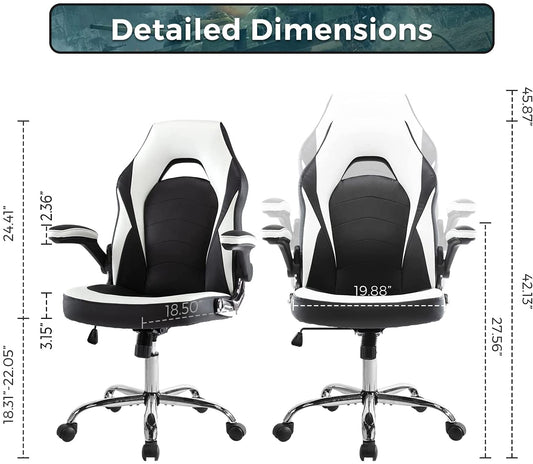
- Seat height range stated — a 400 mm minimum with 100 mm of travel is what lets one chair fit different body sizes.
Red flags: no specifications beyond dimensions and colour; "imported" used as a quality claim with no origin stated; stock photography that doesn't match the described model; no seller name behind the listing.
Every Oakcraft chair publishes all five of those figures on its product page. That isn't a marketing decision — it's the only honest way to sell a chair, and the reason we're comfortable telling you to hold every brand to the same standard.
Our recommendation
Oakcraft [PRODUCT NAME] — ₹[PRICE]
- Seat height: 400 mm minimum, 100 mm hydraulic adjustment
- Mechanism: centre-tilt with lock — recline to a comfortable angle and hold it
- Back support: cushioned lumbar support at a defined contact point
- Headrest: cushioned
- Built by: the manufacturer, in Delhi — not resold
This is the chair we'd put someone in for an eight-hour day. It has the two things a sub-₹2,000 chair structurally cannot have — a locking recline and real lumbar contact — and a cylinder and foam specification built for daily full-time loading rather than occasional use.
Compare those numbers against anything else you're considering. Ask any vendor for the same four figures; if they can't answer, you've learned something useful.
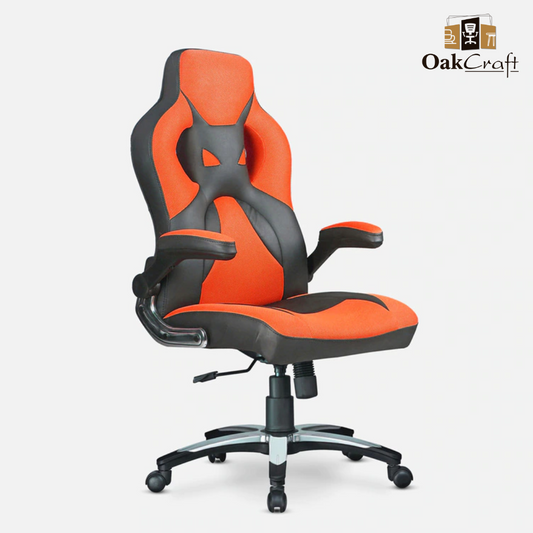
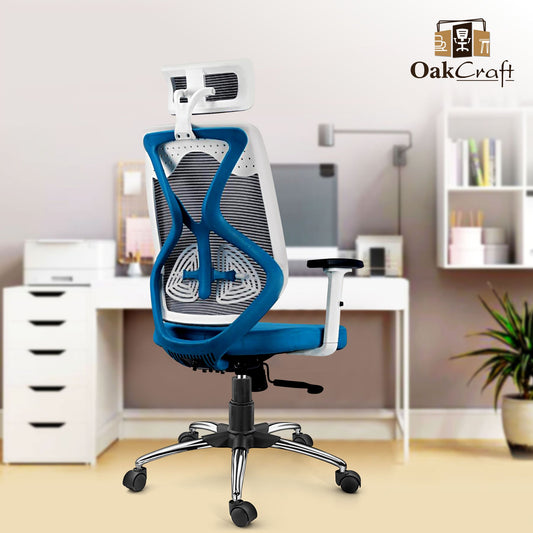
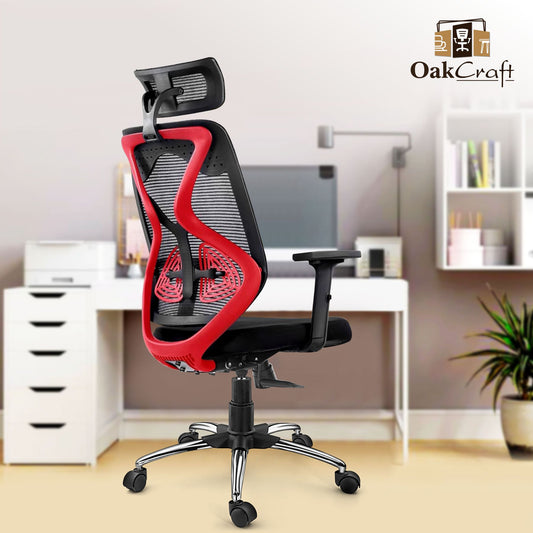
[IMAGE: hero shot of the recommended Oakcraft model, side profile with lumbar contact point visible]
What the next band up actually buys
If you've read this far and concluded you need a chair that survives real use, here's what changes between ₹2,000 and the ₹4,000–7,000 range — and it's not aesthetics.
You get a gas cylinder rated for daily eight-hour loading rather than occasional use. You get a centre-tilt mechanism with a lock, so you can recline to a comfortable open angle and stay there. You get a defined lumbar contact point at the right height rather than a flat panel. You get foam that's still foam in year three. And you get seat height range that actually spans different body sizes — a 400 mm minimum with 100 mm of travel is what lets one chair fit a 5'2" person and a 6' one.
That last point is the one most bulk buyers miss. If you're seating a team, one chair height does not fit everyone on your floor.
If you're buying for an office
We manufacture in Delhi and supply businesses, institutions and government buyers across India, including on GeM. Because we manufacture rather than resell, we can build to a specification instead of asking you to pick from a catalogue — and for a bulk order, per-unit pricing in the ₹4,000–6,000 band gets closer to retail sub-₹2,000 pricing than most buyers expect.
Send us your headcount and we'll come back with a specification and quote — contact@oakcraft.in or WhatsApp [NUMBER].
Frequently asked questions
Can you get a good office chair under ₹2,000 in India? You can get a functional one — mesh mid-back, nylon base, gas lift height adjustment, fixed arms. What you can't get at this price is a locking tilt mechanism, adjustable lumbar support, adjustable armrests or high-density foam. For light use of two to three hours a day that's often enough. For full-time work it usually isn't.
Why do cheap office chairs keep sinking? The gas cylinder. Lower-class cylinders lose their seal and can no longer hold the load. It's the most common failure on budget chairs, and a replacement cylinder costs ₹400–700 — much cheaper than a new chair if the rest is sound.
How long does an office chair under ₹2,000 last? Light use of two to three hours a day: two to three years. Full-time eight-hour use: commonly 12–18 months before the cylinder sinks or the foam flattens.
Is a ₹2,000 chair OK for working from home full time? Not really, if full time means eight hours. The absence of a locking recline and adjustable lumbar support are the two things that matter most over a long day, and neither exists at this price. If your budget is genuinely fixed today, fix the free things first — correct seat height, sit fully back, a rolled towel at belt level, and stand up every 30 minutes — and talk to us when you're ready to buy once instead of three times.
What's the minimum realistic budget for a proper full-time office chair? Around ₹4,000–5,000 in India for one with a locking tilt mechanism, proper lumbar contact, a durable cylinder and foam that lasts. Below that you're paying for a chair shape rather than chair engineering.
Is a study chair the same as an office chair? No. Study chairs are built for shorter sessions and lighter bodies, often with fixed height and no recline. Much of what sells under ₹2,000 as an "office chair" is closer to a study chair in construction.
About Oakcraft
Oakcraft manufactures office, gaming and institutional seating in Delhi and supplies businesses, institutions and government buyers across India, including as a registered seller on the Government e-Marketplace (GeM).