
Office Chair Parts — Names, Functions and What Fails First
Something breaks on your chair and you go to search for it — and you don't know what it's called. So you type "the thing under the chair that goes up and down" and get nowhere.
This page names every part, explains what it does, and tells you which ones fail and what replacements cost in India. It's also the vocabulary you need to read a spec sheet properly before buying, because manufacturers list these components and most buyers skip past them.
Oakcraft manufactures office and institutional seating in Delhi, so the descriptions below come from building these chairs rather than from a catalogue.
Quick answer — the eight main parts
An office chair has eight core components: the backrest, seat, armrests, gas cylinder (height adjustment), mechanism (tilt and recline control), base (the five-star spider), casters (wheels), and lumbar support. The gas cylinder is the part that most commonly fails, and it typically costs ₹400–700 to replace.
The parts, from the top down
Headrest
Supports the neck and head when you recline. Found on high-back chairs; absent on mid-back and task chairs. Adjustable headrests move up, down and sometimes tilt.
Worth knowing: a headrest only does anything if you actually recline. If you sit upright all day, you'll never touch it, and a mid-back chair would serve you just as well.
Backrest
The panel supporting your spine. Three common constructions:
- Mesh — breathable, best for warm and non-air-conditioned rooms, which covers most of India for much of the year
- Leatherette / PU — softer, warmer, easy to clean, best in air-conditioned rooms
- Fabric over foam — a middle ground, but the hardest to clean
Height is described as high-back (supports up to the head), mid-back (up to the shoulder blades) or low-back (lumbar only, typical of visitor chairs).
Lumbar support
The contour or pad that meets the inward curve of your lower back. It should make contact at roughly belt level — not between your shoulder blades.
Three types: integrated (moulded into the backrest, always in the right place but not adjustable), adjustable (slides up and down to suit your torso length), and a detachable pillow on a strap (common on gaming chairs; works, but drifts out of position and flattens over time).
This is the part most people don't check, and it's the one that determines whether the chair suits your back. More on getting it positioned correctly →
Seat
The cushion you sit on. Three things matter:
- Foam density — determines whether it's still comfortable in year three. Low-density foam flattens within months of daily use, and once you can feel the base through it, the chair is finished.
- Seat depth — you want 2–3 fingers of clearance between the front edge and the back of your knee. Too deep and you slide forward off the backrest.
- Waterfall edge — a front edge that curves downward, reducing pressure behind the knees. Standard on office chairs, usually absent on gaming chairs.
Armrests
Described by how many directions they adjust:
| Type | Adjusts |
|---|---|
| Fixed | Nothing |
| 1D | Height only |
| 2D | Height and width |
| 3D | Height, width, and pivot |
| 4D | Height, width, pivot, and forward/back |
Set them so your shoulders stay relaxed with elbows at roughly 90 degrees. If they're fixed at the wrong height for you, ignore them entirely rather than half-using them — leaning onto one armrest all day is a classic cause of one-sided back and neck pain.
The armrest pad is a separate part and often replaceable on its own when it cracks or peels.
Mechanism
The housing bolted under the seat that controls tilt and recline. This is where the levers live, and the type determines how the chair behaves:
- Centre tilt — the whole seat and back tilt together around a central point. Simple, robust, and with a lock it holds a set working angle.
- Synchro tilt — the backrest reclines further than the seat, usually at about a 2:1 ratio, keeping your feet planted as you lean back.
- Knee tilt — pivots near the front of the seat, so your feet stay flat as you recline. Common on executive chairs.
- Multifunction — separate controls for seat angle and back angle.
Most mechanisms also have a tension knob underneath, which sets how much force is needed to recline. Set it to your body weight — if the backrest pushes you forward when you relax, it's too tight.
The lock is what matters most. A recline that won't hold position means you can rock but never settle, and your trunk muscles do the work all day.
Gas cylinder
The metal tube between the seat and the base. Also called the gas lift, pneumatic cylinder or gas strut. This is the part that fails most often.
It contains pressurised nitrogen and a piston. Pull the lever, a valve opens and the chair moves; release it, the gas is trapped, and that trapped gas holds your height.
Cylinders are graded Class 1 to Class 4 by wall thickness, stroke and load rating — Class 3 or 4 for full-time eight-hour use.
When it fails: the seal wears, nitrogen leaks past the piston, and the chair sinks slowly under your weight. Nothing you tighten will fix it. A replacement costs roughly ₹400–700 and takes about fifteen minutes to fit. Full repair guide →
Safety: never cut, drill, puncture or heat a gas cylinder. It's pressurised. Work on the outside only and dispose of old ones intact.
Base
The five-star "spider" the chair stands on. Usually nylon, sometimes metal or chrome on higher-end chairs.
Good nylon is genuinely fine — plenty of quality chairs use it. What matters is wall thickness and grade. Cheap bases crack at the spokes near the caster sockets, usually under heavier users.
Check the diameter: under about 280 mm is small and reduces stability. Better product listings state it.
Note that the base attaches to the cylinder by a friction taper, not a thread. Nothing unscrews — your body weight seats it. That's why removing one takes a rubber mallet rather than a spanner.
Casters
The wheels. Two things to know:
- Stem diameter — most office chairs use a standard 11 mm grip-ring stem, which is why replacement casters are widely interchangeable.
- Wheel material — hard nylon for carpet, soft polyurethane for hard floors. Using hard casters on tile or wood is what scratches your floor, and it's a ₹300 fix that most people never make.
Casters are the cheapest part to replace and the most commonly neglected. Hair and grit wrapping the axle is the usual cause of a chair that suddenly rolls badly.
What fails first, and what it costs
| Part | Typical failure | Approx. replacement cost |
|---|---|---|
| Gas cylinder | Chair sinks under weight | ₹400–700 |
| Casters | Seize, wobble, or scratch floors | ₹200–500 (set) |
| Armrest pads | Crack or peel | ₹300–600 (pair) |
| Seat foam | Flattens, base felt through it | Usually not worth replacing |
| Base | Cracks at spokes | ₹600–1,200 |
| Mechanism | Won't hold recline | ₹800–1,500 |
The general rule: one failed part on an otherwise sound chair is a repair. Three failing parts at once is a chair telling you it's finished.
Using this to buy better
Now that you have the vocabulary, these are the six specifications to demand from any vendor before ordering:
- Gas cylinder class — Class 3 or 4 for full-time use
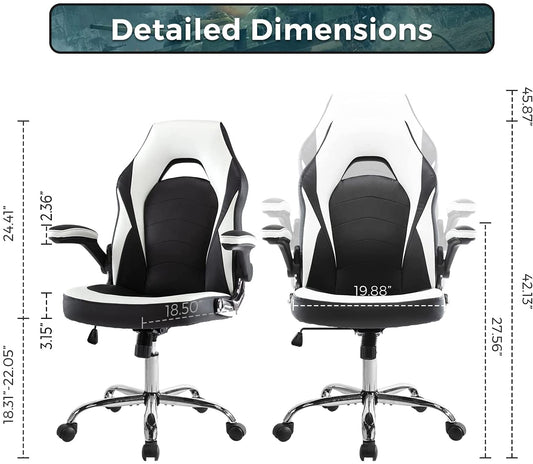
- Seat height range in millimetres — a 400 mm minimum with around 100 mm of travel fits the widest range of body sizes
- Mechanism type, and whether it locks
- Base material and diameter
- Backrest material — mesh for warm rooms, leatherette for air-conditioned ones
- Weight capacity in kg, with the test standard behind it
A supplier who can't answer these about their own chair is a reseller, not a manufacturer. It's the fastest test there is.
Oakcraft parts and chairs
Oakcraft manufactures office, gaming and institutional seating in Delhi and stocks replacement parts for the chairs it makes — because a chair with one worn component shouldn't become landfill. Tell us the model and we can usually tell you what fits.
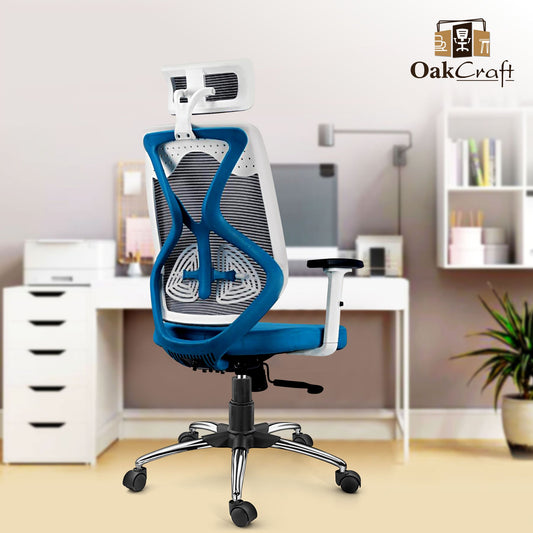
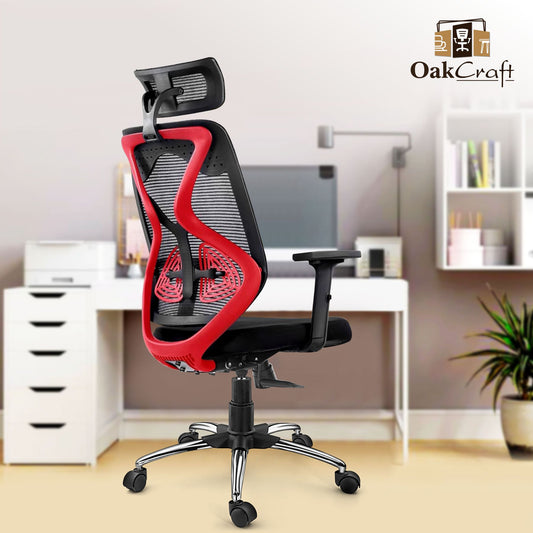
For full-time desk work → Oakcraft Matrix High Back Ergonomic Mesh Office Chair — breathable mesh back, high-back design with lumbar support, centre-tilt mechanism with lock.
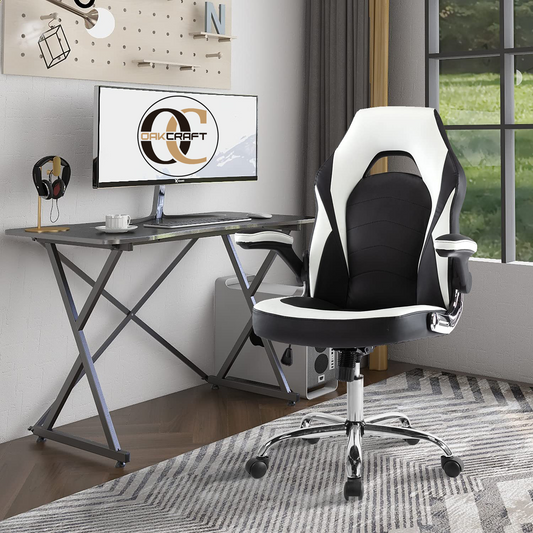
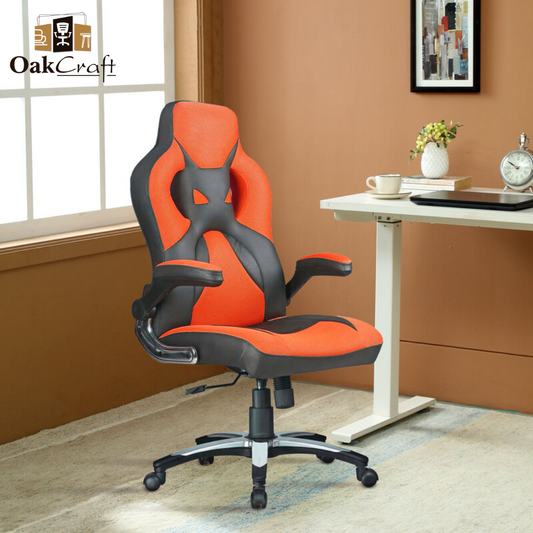
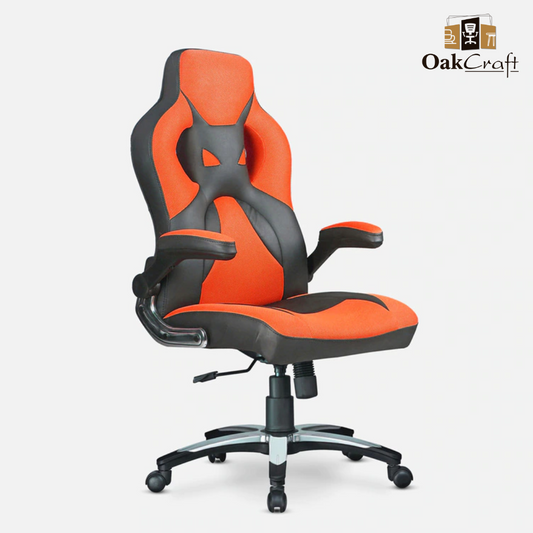
For gaming and mixed use → Oakcraft Vigil High Back Leatherette Gaming Chair — from ₹8,400. High-back with built-in lumbar support, adjustable armrests, recline, premium leatherette.
Bulk enquiries: contact@oakcraft.in or WhatsApp [NUMBER].
[IMAGE: labelled cutaway diagram of a chair with all eight parts named — this is the image the whole page is built around, and the one other sites will link to]
Frequently asked questions
What is the part of an office chair that goes up and down called? The gas cylinder — also known as the gas lift, pneumatic cylinder or gas strut. It sits between the seat and the base and holds your height using trapped pressurised nitrogen.
What are the main parts of an office chair? Headrest, backrest, lumbar support, seat, armrests, mechanism, gas cylinder, base and casters. The mechanism controls tilt and recline; the gas cylinder controls height.
Which office chair part fails first? The gas cylinder, in almost every case. Its seal wears, nitrogen escapes, and the chair sinks under load. Replacement costs around ₹400–700 and takes about fifteen minutes.
Are office chair parts interchangeable between brands? Largely yes. Gas cylinders use a standard taper fitting and most casters use an 11 mm grip-ring stem, so replacements fit across most brands. Measure the taper and overall length before ordering, since stroke lengths vary. Mechanisms and bases are less standardised.
What is the five-star part at the bottom of a chair called? The base, sometimes called the spider or star base. It attaches to the gas cylinder by friction taper rather than screws, and holds the casters.
What's the difference between centre tilt and synchro tilt? Centre tilt moves the seat and backrest together around a central pivot. Synchro tilt reclines the backrest further than the seat, typically at a 2:1 ratio, so your feet stay planted as you lean back.
Can I replace office chair parts myself? Yes for casters, gas cylinders and armrest pads — all are straightforward with basic tools. The one rule is never to cut, drill or heat a gas cylinder, since it holds pressurised nitrogen.
About Oakcraft
Oakcraft manufactures office, gaming and institutional seating in Delhi and supplies businesses, institutions and government buyers across India as a registered seller on the Government e-Marketplace (GeM).