
Your Chair, Your Back: What's Actually Causing the Pain
If your back hurts after a full day at your desk, the problem is usually not that you sat down. It is that you sat still, in a chair that gave your lower back nothing to lean against, at a height that was never adjusted for your body.
Sitting itself is not the villain. Static sitting in an unsupported chair is. Those are two different problems, and only one of them is fixed by buying a better chair — the other is fixed by getting up.
This guide explains what is physically happening in a badly set-up chair, gives you a 60-second audit you can run on your own chair right now, and lists the specifications that separate a chair built for eight hours from one built for eight minutes.
Why sitting loads your lower back more than standing
Researchers have been measuring pressure inside the lumbar discs since the 1960s. The classic studies by Alf Nachemson and colleagues found that pressure on the lower spine is meaningfully higher when seated than when standing, and highest of all when you are slouched forward with no back support.
More recent reviews have refined that picture. When you sit upright and properly supported, disc pressure is much closer to standing than the old figures suggested. The difference is not sitting versus standing. The difference is supported versus unsupported.
Here is the practical version:
| Position | What happens to your lower back |
|---|---|
| Standing | Baseline load, muscles working, spine in natural curve |
| Sitting upright with lumbar support | Load close to standing, curve maintained |
| Sitting with no back support | Higher load, pelvis rolls back, lower back flattens |
| Slouched forward over a keyboard | Highest load of the four, plus sustained stretch on ligaments |
Your chair decides which of those four rows you spend your day in.
There is a second mechanism that gets less attention. Spinal discs have no direct blood supply — they are fed by movement, which pumps fluid in and out. Hold one posture for two hours and you reduce that exchange. This is why the pain often arrives at 4pm rather than 11am, and why it eases within minutes of standing up.
The six things in your chair that cause the pain
1. The seat is too high, so your feet aren't flat
If your feet dangle, or only your toes touch, your thighs take the weight that your feet should be taking. Your pelvis rotates backwards to compensate and your lower back flattens.
Check it: feet flat on the floor, knees at roughly 90 degrees, thighs parallel to the ground. Fix it: lower the seat. If the chair won't go low enough for a shorter user, or high enough for a taller one, the chair's adjustment range is the problem — not the person.
This is why adjustment range matters more than any single dimension. A chair with only 50mm of travel cannot serve a 5'2" employee and a 6'1" employee. A chair with 100mm of travel can.
2. There is a gap between your lower back and the backrest
Put your hand behind your lower back right now. If it slides into an empty space, your lumbar spine is unsupported and holding its own weight for nine hours.
Lumbar support is one of the few chair features with reasonably consistent research behind it. A 2023 study in Ergonomics testing the same chair in four configurations found that the lumbar support and seat-pan tilt conditions produced more neutral spine and pelvic postures than the control setup.
Check it: sit back fully. The curve of the backrest should meet the small of your back — not your mid-back, not your shoulder blades. Fix it: sit fully back in the chair first. Half of all "no lumbar support" complaints are actually "sitting on the front third of the seat" complaints. If you are sitting back properly and the support still lands too high, the chair is the wrong shape for you.
3. The seat is too deep
If the front edge of the seat digs into the back of your knees, you will unconsciously slide forward to relieve it — and once you slide forward, you have lost the backrest entirely.
Check it: two to three fingers of clearance between the seat edge and the back of your knee.
4. The backrest moves, but doesn't lock
Reclining is genuinely good for you. Shifting position periodically unloads the discs and keeps fluid moving. But a backrest that flops freely gives you nothing to push against, so you brace with your back muscles all day instead.
A six-month randomised controlled trial published in 2024 found that an intervention designed to encourage postural shifts significantly reduced the incidence of new neck and low-back pain in office workers. The mechanism was movement, not stillness — the point is not to find one perfect posture and freeze in it.
What you want: a tilt mechanism that reclines and locks, so you can change position several times a day and each position actually holds.
5. The armrests are at the wrong height (this shows up as neck pain)
Too low and you lean sideways. Too high and your shoulders ride up towards your ears all day. Either way the pain often presents in the neck and upper back rather than the lower back, so people blame their monitor instead of their chair.
Check it: elbows at roughly 90 degrees, shoulders relaxed and level, forearms supported without you having to reach down or hunch up.
6. The chair is simply worn out
This is the one nobody checks. Chairs fail quietly:
- Foam has flattened. You are now sitting on a board with fabric on it. Test: press your palm into the seat. If it doesn't spring back, it is done.
- The gas cylinder is sinking. You set the height, and forty minutes later you are lower than you started — and you never notice, because it happens gradually.
- The tilt mechanism has lost tension. The recline no longer holds where you set it.
A three-year-old chair that has been sat in for eight hours a day, five days a week, has absorbed roughly 6,000 hours of use. Foam and gas cylinders are consumable parts. When they go, the chair stops doing the one job you bought it for — and the person sitting in it starts compensating with their back.
The 60-second chair audit
Run this at your own desk. Everything should be a yes.
- Feet flat on the floor, knees at about 90 degrees
- Sitting fully back, with the backrest meeting your lower back
- Two to three fingers of clearance behind your knees
- Elbows at about 90 degrees, shoulders relaxed
- Top of your monitor at roughly eye level, about an arm's length away
- The backrest reclines and locks in position
- The seat height stays where you set it for the whole day
- The seat foam springs back when you press it
Any "no" that you cannot fix by adjusting the chair is a specification problem, not a posture problem. No amount of sitting correctly will fix a chair that does not adjust.
What a chair built for eight hours actually has
When you are buying — for yourself or for forty people — these are the specifications worth reading on the spec sheet. Not the marketing copy. The numbers.
| Specification | What to look for | Why it matters |
|---|---|---|
| Minimum seat height | 400mm | Below this, taller users sit with knees above hips |
| Height adjustment range | 100mm | One chair has to fit a 5'2" and a 6'1" employee |
| Height mechanism | Hydraulic / gas lift | Must hold position all day, not sink |
| Lumbar support | Present, meeting the lower back | The single most evidenced feature |
| Tilt mechanism | Centre tilt with lock | Lets you change position and have it hold |
| Armrests | Cushioned, elbow-height | Shoulder and neck load, not just comfort |
| Headrest | Fixed, cushioned | Relevant if you recline or take calls |
| Seat cushioning | High-density foam | Determines whether the chair lasts 3 years or 7 |
| Warranty | Minimum 1 year | The manufacturer's own confidence, stated in writing |
| Spare parts | Available separately | One failed part shouldn't mean a new chair |
That last row matters more than people expect. Most office chairs are thrown away because of one failed component — a castor, an armrest, a gas cylinder. If the manufacturer stocks spares, an eight-year-old chair stays in service. If it doesn't, you are buying a new chair every third year and calling it a furniture budget.
Where Oakcraft fits
We manufacture office chairs in India, and we build to that specification list rather than to a price point.
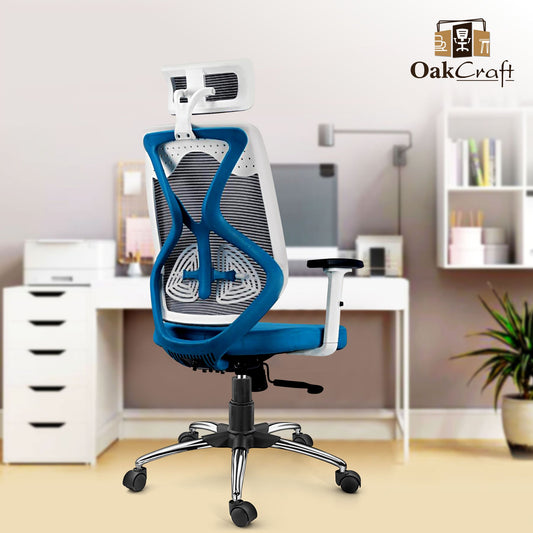
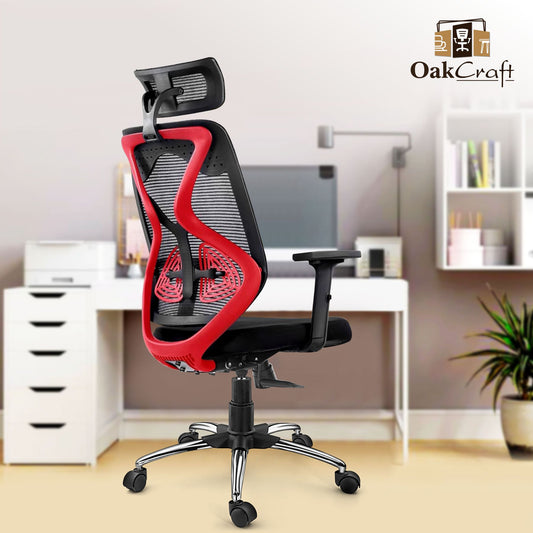
Our standard revolving chair is built with a 400mm minimum seat height and 100mm of hydraulic adjustment range, a centre-tilt mechanism that locks, lumbar support, cushioned armrests, and a fixed cushioned headrest — with a minimum one-year warranty and spare parts available individually.
Three things are worth saying plainly:
We manufacture, we don't resell. For bulk orders that means the catalogue is a starting point, not a limit. Back height, upholstery, colour to match your brand, mechanism — tell us the specification and we build to it.
We stock spare parts. Castors, armrests, mechanisms. When one component fails on a chair, you replace that component.
We're a registered seller on GeM. Government departments and PSUs can order through their existing Government e-Marketplace process, with prices already published — no separate vendor registration required.
If you are furnishing an office, or replacing chairs that have quietly stopped working, talk to us about a bulk requirement or send us your specification.
When it isn't your chair
An honest note, because this is where furniture companies usually overreach.
A good chair reduces the mechanical load on your back and lets you change position. It is not a treatment. Back pain has many causes — muscle strength, general activity levels, sleep, stress, and specific medical conditions among them — and a chair addresses only one part of that picture.
Please see a doctor or a qualified physiotherapist if you have:
- Pain that travels down one leg, or numbness, tingling or weakness in a leg or foot
- Pain that wakes you at night or is present when you are lying down
- Back pain following a fall or injury
- Pain that has not improved after a few weeks, or is getting worse
- Any loss of bladder or bowel control — this needs urgent medical attention
If your pain clearly improves within minutes of standing up and returns when you sit back down, that pattern points strongly towards your seated setup. That is the version this article can help with.
Frequently asked questions
Why does my back hurt only in the afternoon? Because the load is cumulative. Muscles fatigue, discs lose fluid exchange over hours of static posture, and your posture gradually degrades — most people are noticeably more slumped after two hours than they were in the first ten minutes. Standing and moving briefly every 30 to 45 minutes interrupts that build-up.
Is standing at a desk better for my back? Not automatically. Standing all day produces its own problems — leg, foot and lower-back muscle fatigue. What the research consistently favours is alternating, because the benefit comes from changing position rather than from any single position being correct.
Will an ergonomic chair cure my back pain? No, and be sceptical of anyone who says otherwise. A well-specified, correctly adjusted chair reduces the load your back carries during the working day, and studies of ergonomic interventions show meaningful reductions in reported musculoskeletal discomfort. That is a real benefit. It is not a cure, and it does not replace medical advice.
How much should a decent office chair cost in India? Enough that the seat foam, the gas cylinder and the mechanism are specified rather than assumed. The cheapest chairs on the market typically save money in exactly those three components, which is why they feel fine in the showroom and flatten within a year. For bulk purchases, ask for the specification sheet and compare the numbers in the table above — not the photographs.
How often should office chairs be replaced? A well-built chair in daily office use should give you five to seven years. If your chairs are failing at two to three, the usual causes are low-density seat foam and low-grade gas cylinders. Where spares are available, replacing the failed component is far cheaper than replacing the chair.
Can I fix a chair that keeps sinking? Usually, yes. A chair that will not hold its height has a failed gas cylinder, and that is a replaceable part on most office chairs. It does not require a new chair.
My chair has lumbar support but my back still hurts. Why? The two most common reasons: you are sitting on the front half of the seat, so you never actually touch the support; or the support sits too high and is meeting your mid-back instead of the small of your back. Sit fully back and check with your hand where the curve lands.
Sources
- Nachemson A. The lumbar spine: an orthopaedic challenge. Spine, 1976 — classic intradiscal pressure measurements across postures.
- Claus A, et al. Sitting versus standing: does the intradiscal pressure cause disc degeneration or low back pain? Journal of Electromyography and Kinesiology, 2008 — review qualifying the older figures.
- Effect of office chair design features on lumbar spine posture, muscle activity and perceived pain during prolonged sitting. Ergonomics, Vol 66, No 10, 2023.
- The effectiveness of a dynamic seat cushion in preventing neck and low-back pain among high-risk office workers: a 6-month cluster-randomised controlled trial. Scandinavian Journal of Work, Environment & Health, 2024.
- Robertson M, et al. The effectiveness of a chair intervention in the workplace to reduce musculoskeletal symptoms. BMC Musculoskeletal Disorders.