
Back Pain From Sitting All Day — What's Actually Causing It
It starts around four in the afternoon. A dull ache low in the back, on one side or across both. You shift in the chair. It helps for ten minutes. By six you're standing up carefully, the way people do when they expect it to hurt.
Almost every desk worker in India recognises this. A systematic review of low back pain in India put the lifetime prevalence at roughly 66% of the population, and studies of IT professionals have reported back symptoms in over 60% of workers in a single week. Among office workers globally, the reported prevalence of low back pain generally lands somewhere between a third and a half.
So you are not unusual, and you are not imagining it. But the standard explanation you'll hear — "you have bad posture" — is mostly wrong, and it's the reason so many people buy a new chair and stay in pain.
Here's what's actually going on.
First, the myth that needs to die
For fifty years the accepted story went like this: sitting compresses your spinal discs far more than standing does, so sitting damages your back.
That came from Alf Nachemson's pressure studies in the 1960s and 70s, which measured pressure inside the lumbar discs in different positions and found sitting loaded the spine considerably more than standing. It's the source of every "sitting is the new smoking" infographic you've ever seen.
The problem is that when Wilke and colleagues repeated the measurements in 1999 with better instruments, they did not find that sitting loads the spine more than standing. A 2022 meta-analysis found the older studies showed higher pressure in sitting, but studies published after 1990 showed no meaningful difference between the two positions. Reviews have since concluded that the compression involved in sitting is unlikely on its own to threaten a healthy disc.
This matters practically, and here's why: if sitting itself were the problem, standing desks would have cured everyone. They haven't. A laboratory study of office workers standing for one hour found low back pain rose from 15% of participants to 40% after just thirty minutes of standing.
Thirty minutes. Standing.
Which points at the real culprit.
Cause 1: It's the duration, not the position
The thing your back objects to is not sitting. It's not moving.
Hold any position long enough and the same sequence happens. The muscles holding you there fatigue. Blood flow through them drops. The soft tissue at the back of your spine — ligaments and joint capsules — takes a slow, sustained stretch it was never designed to hold for eight hours. Discs, which have no blood supply and depend on movement to exchange fluid, sit static.
The ache at 4pm is a fatigue signal, not an injury signal. Which is why standing up fixes it for ten minutes, and why nothing you buy will fix it if you never get up.
The rule that matters more than any product: change position roughly every 30 minutes. Not a walk. Stand up, take four or five steps, sit back down. Thirty seconds. The physiotherapy line is "the best posture is your next posture," and it's the single most useful sentence in this whole article.
Cause 2: Your pelvis rolls backwards, and your lower back pays
Here is the mechanism most people have never had explained to them.
Stand up. Your pelvis sits fairly upright and your lower back holds its natural inward curve. Now sit down on a flat surface. Your hamstrings tether the back of your pelvis, and after a few minutes it rolls backwards — physios call this posterior pelvic tilt. When your pelvis rolls back, your lower back has no choice but to flatten and then round.
That rounded lower back is what you actually mean when you say you're "slouching." Nobody decides to slouch. Your pelvis decides for you, and your spine follows.
Two things determine whether this happens to you: how long you've been sitting, and whether your chair supports your pelvis or just your ribcage. This is the entire point of lumbar support, and it's why a firm cushion at the right height works and an expensive chair with the lumbar pad in the wrong place doesn't.
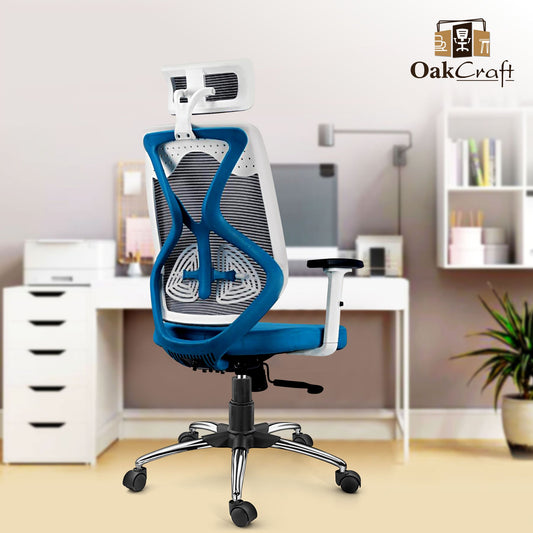
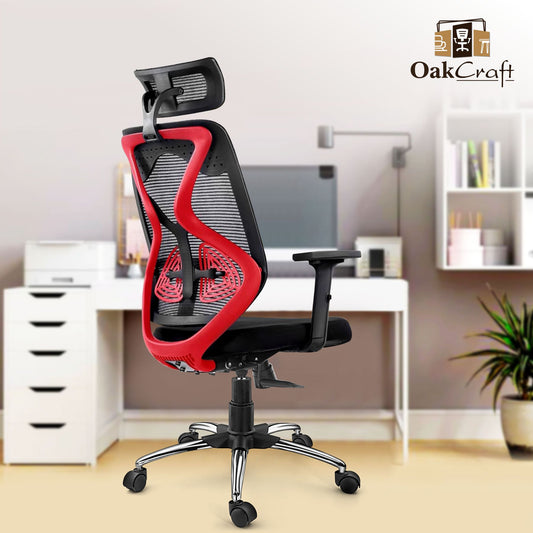
The lumbar support needs to make contact at the inward curve of your lower back — roughly at belt level, not between your shoulder blades. If your chair's lumbar section is fixed and lands in the wrong place on your body, it isn't supporting you. It's just furniture.
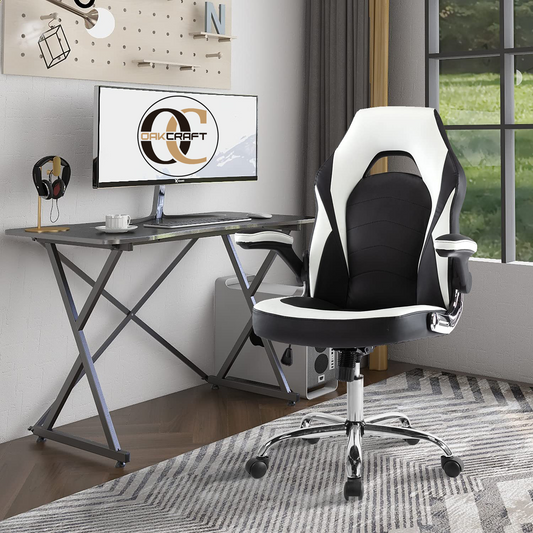
Check your own chair: press your fist into your lower back at belt level while sitting. If the chair gives you nothing there, that gap is doing eight hours of damage a day. Every chair in the Oakcraft office seating range is built with a defined lumbar contact point rather than a flat backrest panel.
[IMAGE: side profile of an Oakcraft chair with the lumbar contact point marked — this is the highest-value image on the page]
Cause 3: The chair doesn't fit you
Most office chairs in India are sold on appearance and price. Almost none are sold on fit. Five measurements decide whether a chair works for your body:
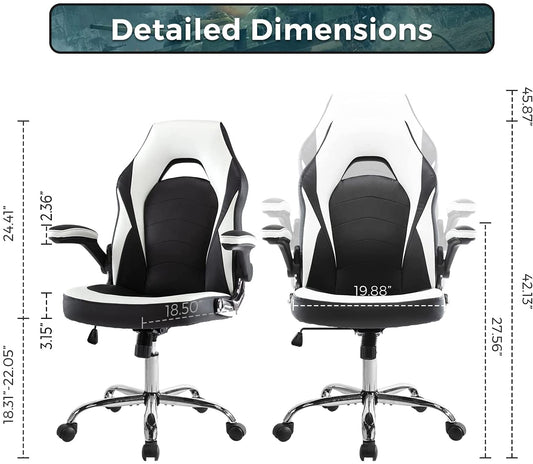
Seat height. Feet flat on the floor, knees at roughly 90 degrees, thighs approximately parallel to the ground. If your feet dangle, your thighs carry your leg weight and your pelvis rolls back. If your knees are higher than your hips, your pelvis rolls back even harder. A usable office chair should adjust from about 400 mm at its lowest and offer at least 100 mm of travel — that range is what lets one chair fit a 5'2" person and a 6' person.
Seat depth. With your back against the backrest, you should be able to fit two or three fingers between the front edge of the seat and the back of your knee. Too deep, and you physically cannot reach the backrest without sliding your pelvis forward — which forces the exact rounded posture you're trying to avoid. This is the single most common fitting error, and it's the reason so many people sit perched on the front third of a perfectly good chair.
Lumbar contact point. As above: belt level, firm, present.
Armrest height. Shoulders relaxed, elbows at roughly 90 degrees, forearms supported. Armrests that are too high shrug your shoulders up all day. Too low and you lean sideways onto one — a classic cause of one-sided back and neck pain. If they're fixed and wrong, ignore them entirely rather than half-using them.
Backrest recline and lock. You want to be able to lean back. Reclining transfers a meaningful share of your upper body weight onto the backrest instead of your lumbar spine, and a tilt mechanism with a lock lets you hold a comfortable open angle rather than sitting rigidly at 90 degrees. A chair that only sits bolt upright is asking your muscles to do work the chair should be doing.
Roughly 100–110 degrees between torso and thighs is more comfortable and better tolerated than the textbook right angle that ergonomics posters keep drawing.
How our own chairs measure up on this list: the Oakcraft [PRODUCT NAME] is built to a 400 mm minimum seat height with 100 mm of hydraulic adjustment, a centre-tilt mechanism that locks at whatever recline angle suits you, cushioned lumbar support and a cushioned headrest. We're listing the numbers rather than adjectives because the numbers are what you should be comparing across every brand you look at — including ours. Ask any vendor for these four figures. If they can't give them to you, that tells you something.
[IMAGE: Oakcraft chair with the five measurements labelled — seat height, seat depth, lumbar point, armrest height, recline angle. Use as the featured image if it comes out well.]
Cause 4: Your desk and monitor are dragging you forward
The chair gets the blame; the desk often deserves it.
If your monitor is too low — and a laptop on a desk is always too low — you drop your head forward. Your head weighs 4 to 5 kg. Move it forward and the load through your neck and upper back multiplies, your upper back rounds to compensate, and your lower back rounds under that. The chain starts at your eyes and ends at your lumbar spine.
Monitor top edge at roughly eye level, screen about an arm's length away, keyboard and mouse close enough that your elbows stay near your body. If you work on a laptop for more than an hour a day, a ₹500 laptop stand plus a separate keyboard will do more for your back than a ₹15,000 chair will.
Standard desk height in India runs around 750 mm, which is fine for someone about 5'8" and increasingly wrong the further you are from that. If your desk is too tall and can't be changed, raise the chair and put a footrest under your feet — a stack of old files works.
Cause 5: The other sixteen hours
Uncomfortable, but true: a back that hurts after sitting is often a back that isn't conditioned to do much of anything.
The muscles that stabilise your lumbar spine — glutes, deep abdominals, the small muscles alongside the spine — get functionally switched off by prolonged sitting and never get loaded anywhere else in a modern day. Then you spend twenty minutes lifting a suitcase on a Saturday and something goes.
Nothing in an office fixes this. Walking, some basic strength work twice a week, and hip mobility do. If your back pain is genuinely posture-related, movement outside work hours will change it more than any purchase.
Cause 6: Stress — and this is not a soft point
Psychological stress raises baseline muscle tension, particularly through the shoulders and lower back, and the research on low back pain in office workers repeatedly flags job stress and low job satisfaction as risk factors alongside the physical ones.
If your back hurts specifically during your worst weeks, that correlation is real and worth noticing. It doesn't mean the pain is in your head. It means muscle tension has more than one input.
Diagnose your own setup in five minutes
Sit the way you normally sit and check honestly:
- Are both feet flat on the floor? No → seat too high, or desk too high.
- Can you fit 2–3 fingers between the seat edge and the back of your knee? No → seat too deep for you.
- Is your back actually touching the backrest right now? No → seat depth or the chair is too upright.
- Does anything press against your lower back at belt level? No → no effective lumbar support.
- Are your shoulders relaxed with forearms supported? No → armrest or desk height.
- Is the top of your screen at about eye level? No → monitor or laptop height.
- When did you last stand up? More than 30 minutes ago → this is your main problem.
Most people fail four of these. Very few of the failures need a new chair to fix.
Fix it in this order
Free, today: Stand every 30 minutes. Set a recurring reminder — you will not remember on your own. Drop your seat until your feet are flat. Slide fully back so you're actually using the backrest. Roll up a towel and place it at belt level for a week to test whether lumbar support is your issue.
Under ₹1,000: A footrest if your desk is too tall. A laptop stand and external keyboard. A firm lumbar cushion.
Then, and only then, the chair. Replace it if it can't be adjusted to pass the checklist above — if the height doesn't adjust or has sunk, if the seat is too deep for your leg length, if there's no lumbar contact, if it won't recline or won't hold a recline, or if the foam has flattened to the point where you can feel the base through it.
Buying a chair first and skipping the free fixes is how people spend ₹12,000 and stay sore.

If your chair does fail that test, browse the Oakcraft range here — every model lists its seat height range, seat depth, lumbar position and tilt mechanism on the product page, so you can check it against the seven-point list above before you order. Buying for a team? Send us your headcount and we'll tell you which model fits, including whether you need more than one seat size across the floor.
When it isn't the chair — see a doctor
Ergonomics has limits. Get it properly examined if you have:
- Pain running down one leg past the knee, or numbness/tingling in the leg or foot
- Weakness in a leg or foot
- Numbness around the groin or inner thighs, or any change in bladder or bowel control — this one is urgent, same day
- Pain that's worse at night or wakes you from sleep
- Unexplained weight loss or fever alongside back pain
- Pain that hasn't improved at all after six weeks
None of that is a furniture problem. A better chair may still help, but it is not the answer to those symptoms.
Frequently asked questions
Does sitting all day really damage your spine? Current evidence doesn't support the idea that sitting damages a healthy disc through compression alone. Studies since 1990 have found little difference in lumbar disc pressure between sitting and standing. The problem is prolonged static loading and lack of movement, not the sitting position in itself.
How long should I sit before standing up? Around 30 minutes. It doesn't need to be a break — standing for thirty seconds and sitting back down resets the muscle fatigue and fluid exchange your back is complaining about.
Will a standing desk fix my back pain? Not by itself. Standing still for long periods produces its own back pain — one study saw it rise from 15% to 40% of participants within thirty minutes of standing. Alternating between sitting and standing helps; replacing one static posture with another doesn't.
Is an expensive ergonomic chair worth it? Only if it adjusts to your body. A ₹6,000 chair that fits you will outperform a ₹25,000 chair that doesn't. Judge by adjustability — seat height range, seat depth, lumbar position, recline with lock — not by price or by how many levers it has. Oakcraft publishes those four figures on every product page for exactly this reason.
Where should lumbar support sit? At the inward curve of your lower back, roughly belt level. If a chair's lumbar pad sits between your shoulder blades on your body, it isn't doing the job for you.
Can a chair alone fix back pain? No. A chair that fits removes an obstacle. Movement, conditioning and a correctly set-up desk do the rest. Anyone selling you a chair as a cure is overselling.
About Oakcraft
Oakcraft manufactures office, gaming and institutional seating in Delhi and supplies businesses, institutions and government buyers across India, including as a registered seller on the Government e-Marketplace (GeM). Because we manufacture rather than resell, we can build to a specification instead of asking you to pick from a catalogue — which matters when you're seating forty people of forty different heights.
Replacing chairs for a team? Send us your headcount and floor layout and we'll come back with a specification and quote — contact@oakcraft.in or WhatsApp [NUMBER]. No minimum order.