
How to Choose an Office Chair — A Complete Buyer's Guide
Most office chair advice is a list of features. That's the wrong starting point, because the same chair that's excellent for one person is wrong for another — and the deciding factor is usually not the price.
The two questions that actually determine what you should buy are how many hours a day you'll sit in it and whether the room is air-conditioned. Everything below follows from those.

Oakcraft manufactures office and institutional seating in Delhi, so this is written from the build side. Where we recommend our own chairs we say so.
Quick answer
How do you choose an office chair? Match it to your daily sitting hours first, then check seven things: seat height range, seat depth, lumbar support position, gas cylinder class, mechanism with a lock, backrest material suited to your room, and warranty.
What's the minimum realistic budget for full-time use in India? Around ₹4,000–5,000. Below that you don't get a locking tilt, adjustable lumbar support or a cylinder rated for eight-hour daily loading.
What's the most common buying mistake? Choosing by appearance and price without checking seat depth. A chair too deep for your leg length forces you to perch on the front edge, and no other feature can compensate.
Step 1: Start with your hours
This determines your entire budget band, and it's the question most buyers skip.
| Daily use | What you need | Realistic budget |
|---|---|---|
| Under 3 hours | Basic revolving chair, height adjustment | ₹2,000–4,000 |
| 3–6 hours | Locking tilt, real lumbar support | ₹4,000–7,000 |
| 6–9 hours | All of the above plus durable cylinder and foam | ₹6,000–12,000 |
| Full-time, plus back pain | Adjustable lumbar, seat depth if possible | ₹8,000+ |
Why the sub-₹2,000 band is a false economy for full-time use: a cheap chair in eight-hour daily use commonly needs replacing within 12–18 months. Over five years that's three or four chairs — roughly the same money as buying once properly, with more disruption. Full breakdown of what ₹2,000 buys →
Step 2: Seat height range — the fit test
A chair should let you sit with feet flat on the floor, knees at roughly 90 degrees, thighs approximately parallel to the ground.
If your feet dangle, the weight of your legs drags your pelvis into a backward roll and your lower back flattens. If your knees sit higher than your hips, the same thing happens harder.
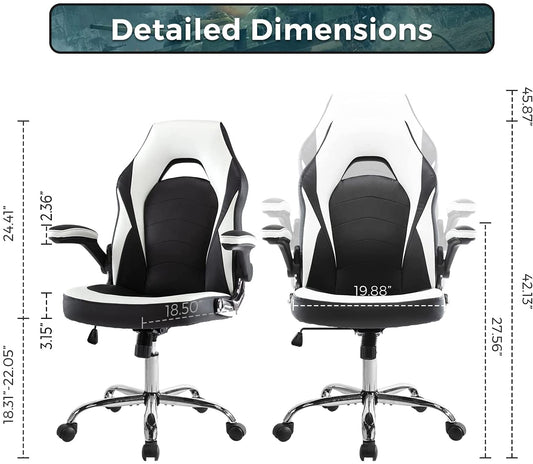
What to demand: the seat height range in millimetres, not the word "adjustable." A 400 mm minimum with around 100 mm of travel is what lets one chair fit a 5'2" person and a 6' person. If a vendor answers with adjectives, they don't know their own product.
Step 3: Seat depth — the check nobody makes
Sit fully back against the backrest. You should fit two to three fingers between the front edge of the seat and the back of your knee.
Too deep and the seat edge presses behind your knee, so you instinctively slide forward — and once you're perched on the front third, your back can't reach the backrest at all. You've turned a good chair into a stool.
This is the single most common fitting failure, and it's invisible. People assume they're bad at sitting up straight. They're not; the chair is too deep for their legs.
If you can't test it in person, compare the seat depth measurement against your own thigh length, measured from the back of your knee to your buttock while seated.
Step 4: Lumbar support — and where it must sit
Your lower back curves inward. The chair has to meet that curve, at roughly belt level — not between your shoulder blades.
Three kinds:
- Integrated contour — moulded into the backrest. Always in position, but fixed. Fine if it lands right for your torso.
- Adjustable — slides up and down. Best option if you're outside average height in either direction.
- Detachable pillow on a strap — common on gaming chairs. Works, but drifts out of position through the day and flattens over months.
Quick test: sit back normally and slide your hand behind your lower back. If it passes through with room to spare, that chair gives you no effective lumbar support. More on positioning it correctly →
Step 5: The gas cylinder — ask for the class
The metal tube between the seat and base. It's the part that fails first, and almost nobody checks it before buying.
Cylinders are graded Class 1 to Class 4 by wall thickness, stroke and load rating. Class 3 or 4 for full-time use. Budget chairs typically ship with Class 1 or 2, and often the listing doesn't state the class at all — which tells you something in itself.
When the seal wears, nitrogen leaks past the piston and the chair sinks under your weight. Nothing you tighten will fix it. Why chairs sink and how to repair it →
Step 6: The mechanism — does the recline lock?
Leaning back slightly transfers a share of your upper body weight onto the backrest instead of down through your lumbar spine. Roughly 100–110 degrees between torso and thighs is more comfortable than the textbook right angle.
You want a mechanism that holds that angle — centre tilt, synchro tilt or knee tilt, with a lock. A chair that only rocks, or only sits bolt upright, makes your trunk muscles do the work for eight hours.
Also check for a tension knob underneath, which sets how much force is needed to recline. If the backrest pushes you forward when you relax, it's set too tight for your weight.
Step 7: Material — the India-specific decision
This is the factor global buying guides skip entirely, because they're written for temperate climates.
Mesh breathes. In a room that isn't air-conditioned — which describes most Indian offices for much of the year — this is the deciding factor over a long day.
Leatherette / PU is warmer, softer and much easier to clean. Genuinely the nicer material in an air-conditioned room. Quality decides whether it cracks at the seat edges in year two.
Fabric over foam sits in between and is the hardest to clean.
The rule: air-conditioned room, leatherette is fine and probably nicer. Non-air-conditioned room where you sit all day, choose mesh.
Step 8: Warranty and spares
A warranty is a manufacturer's own estimate of product life, expressed as a financial commitment. One year tells you something. Three years tells you something else.
Ask two things: what it covers — mechanism and gas cylinder, or only manufacturing defects — and whether spares will exist in five years. The second question is the cleanest way to separate a manufacturer from a reseller, because a reseller will have moved to a different model from a different source.

The seven-point checklist
Take this to any vendor:
- Seat height range in mm? (400 mm min, ~100 mm travel)
- Seat depth — 2–3 fingers behind the knee when seated fully back
- Lumbar support at belt level? Fixed or adjustable
- Gas cylinder class? (3 or 4 for full-time use)
- Does the recline lock?
- Mesh or leatherette — matched to whether the room is air-conditioned
- Warranty terms in writing, and spares availability
A supplier who can't answer questions 1, 4 and 5 about their own chair is reselling, not manufacturing.
Special cases
Working from home full-time. Prioritise the mechanism lock and lumbar support over appearance. You'll sit in this longer than most office workers sit in theirs.
You already have back pain. Adjustable lumbar support becomes the top priority, because you need it at your height rather than where a fixed contour happens to fall. A chair removes an obstacle; it doesn't treat anything. What actually causes back pain from sitting →
Gaming and work on one chair. Buy the office chair with a headrest. It's the one that has to survive eight hours; the gaming hours will be fine. Full comparison →
Buying for a team. Order more than one seat size if your people vary in height, and buy 2–3 spares upfront — batch colours drift and models get discontinued. Cost planning for a full office →
You're tall or short. Seat height range and seat depth matter more than anything else on this page. Adjustable lumbar becomes close to essential.

Our recommendation
Oakcraft manufactures in Delhi and publishes seat height range, cylinder class and mechanism type on every product page — because those are the figures this guide tells you to demand, and it would be strange to withhold them.
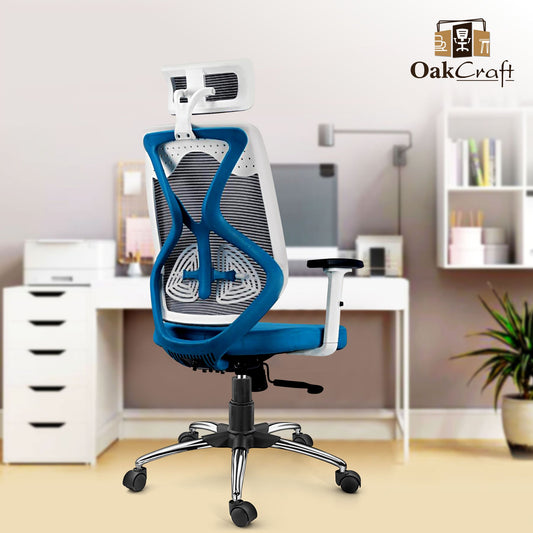
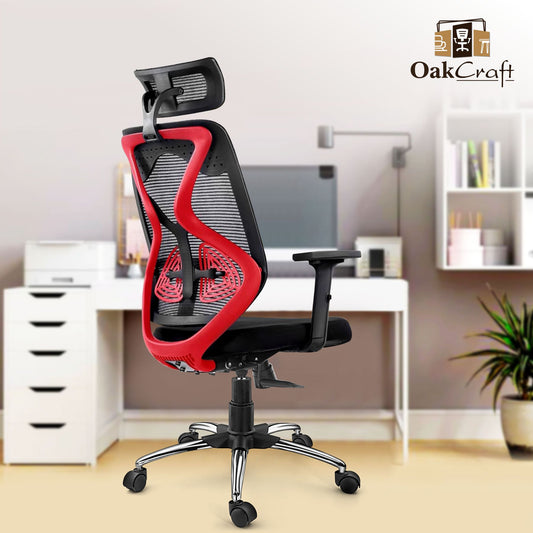
For full-time desk work → Oakcraft Matrix High Back Ergonomic Mesh Office Chair — breathable mesh back for warm and non-air-conditioned rooms, high-back design with lumbar support, centre-tilt mechanism with lock.
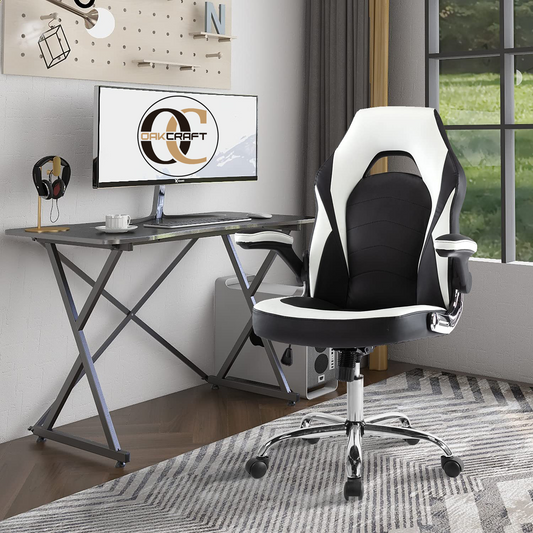
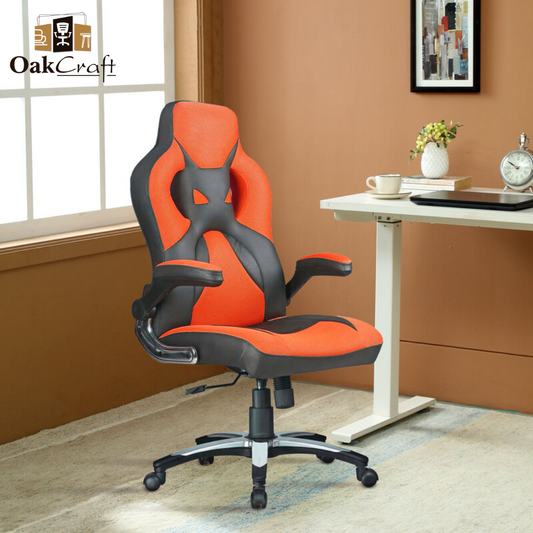
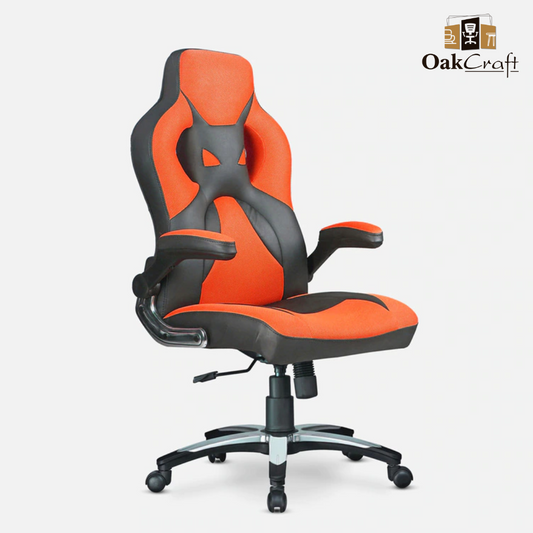
For gaming and mixed use → Oakcraft Vigil High Back Leatherette Gaming Chair — from ₹8,400. High back with built-in lumbar support, adjustable armrests, recline, premium leatherette.
Certified to ANSI/BIFMA E3 Level 3, ISO 9001:2015 and ISO 45001:2018. Three-year warranty, replacement over repair. Replacement parts stocked for the chairs we make.
Buying for a team? Send headcount, floor layout and whether the space is air-conditioned — contact@oakcraft.in or WhatsApp [NUMBER].

Frequently asked questions
How do I choose the right office chair? Start with how many hours a day you'll use it, then check seat height range, seat depth, lumbar support position, gas cylinder class, whether the recline locks, backrest material matched to your room, and warranty terms.
What should I look for in an office chair for long hours? A locking recline mechanism, lumbar support that meets your lower back at belt level, a Class 3 or 4 gas cylinder, and a seat depth that lets you sit fully back with 2–3 fingers of clearance behind the knee.
How much should I spend on an office chair in India? Around ₹4,000–5,000 minimum for full-time use. Below that you don't get a locking tilt, real lumbar support or a cylinder rated for daily eight-hour loading, and replacement within 12–18 months is common.
Is mesh or leather better for an office chair? Mesh in rooms that aren't air-conditioned, because it breathes. Leatherette in air-conditioned rooms, where it's warmer, softer and easier to clean.
What seat height should an office chair have? One that lets your feet rest flat on the floor with knees at roughly 90 degrees. A range starting around 400 mm with about 100 mm of adjustment accommodates most adult heights.
How do I know if an office chair is too big or too small for me? Sit fully back. If you can't fit 2–3 fingers between the seat's front edge and the back of your knee, it's too deep. If your feet don't reach the floor at the lowest setting, it's too tall.
Does an expensive office chair make a difference? Only if it adjusts to your body. A ₹6,000 chair that fits will outperform a ₹25,000 chair that doesn't. Judge by adjustability, not price or lever count.
About Oakcraft
Oakcraft manufactures office, gaming and institutional seating in Delhi and supplies businesses, institutions and government buyers across India as a registered seller on the Government e-Marketplace (GeM).