
How an Office Chair Is Made — Inside the Manufacturing Process
Oakcraft is an office chair manufacturer in Delhi, producing office, gaming and institutional seating in-house. This is what actually happens between raw material and a finished chair — eight stages, and the point at each one where cost gets taken out.
It's worth understanding for a practical reason: it tells you what to ask a supplier. Most companies selling office chairs in India don't make them, and the questions below are the ones that reveal which is which.
Quick answer
How is an office chair made? In eight stages: frame fabrication, foam moulding, upholstery cutting and sewing, backrest production, component sourcing (gas cylinder, mechanism, base, casters), sub-assembly, final assembly, and quality testing.
Which parts do manufacturers typically make versus buy? Most manufacturers produce the frame, foam, upholstery and backrest in-house, and buy gas cylinders, mechanisms, bases and casters from specialist component makers. That's normal — those components require entirely different tooling. The distinction that matters is whether a company makes the chair at all, or simply imports finished chairs and puts a label on them.
Stage 1: Frame fabrication
The internal skeleton — usually steel tube or plate for the seat pan and backrest support, sometimes moulded plywood.
Tube is cut to length, bent on a mandrel bender, welded at the joints, then ground and treated against corrosion. On a well-made chair the welds are continuous where load passes through them, and the frame is powder-coated rather than painted, because paint chips at contact points and rust follows.
Where cost gets cut: thinner-gauge tube, spot welds instead of continuous ones, and skipping surface treatment on parts that will be hidden under upholstery. None of it is visible on delivery day. All of it shows up in year three.
Stage 2: Foam moulding
Two methods, and the difference is significant.
Moulded foam is poured into a chair-shaped mould and cured. It comes out with density built in and holds its shape because it was formed as that shape.
Cut foam is sliced from a large block with a CNC or band cutter. Cheaper, faster, and more prone to flattening at pressure points because the cell structure was never formed for that geometry.
Foam is specified by density — how much material is in a given volume — and this is the single biggest determinant of whether a seat is still comfortable in year three. Low-density foam feels identical in the showroom and compresses within months of daily use. Once you can feel the base through the seat, the chair is finished.
Where cost gets cut: density, straightforwardly. It's invisible, unmeasurable by the buyer, and it's the most common place a cheap chair is cheap.
Stage 3: Upholstery cutting and sewing
Fabric, mesh or leatherette is cut to pattern — by die or CNC on volume runs — then sewn, and the panels are stretched over the foam and frame and fixed with staples, clips or a hidden zip.
Three things separate good upholstery work: stitch density at seams that take load, whether panels are cut on the correct grain so they don't distort, and how corners are handled. Corners are where cheap upholstery fails first.
On material choice for India: mesh breathes and suits non-air-conditioned rooms, which covers most Indian offices for much of the year. Leatherette is warmer, softer and easier to clean, and belongs in air-conditioned spaces. Quality of PU decides whether it cracks at the seat edges in year two.
Stage 4: Backrest production
Mesh backs are built differently from upholstered ones. A mesh backrest is a frame with fabric stretched across it under controlled tension — too loose and it sags within months, too tight and it tears at the mounting points.
Lumbar support is formed at this stage: either moulded into the backrest contour, or built as a separate adjustable component that slides on a track. Where that contour sits determines whether the chair supports the person, and it's set here, on the factory floor, not at the customer's desk.
Stage 5: The bought-in components
No chair manufacturer in the world makes everything. Four components come from specialist producers:
- Gas cylinder — a sealed nitrogen pressure vessel. Graded Class 1 to 4 by wall thickness, stroke and load rating. Class 3 or 4 for full-time use.
- Mechanism — the tilt and recline housing. Centre tilt, synchro tilt, knee tilt or multifunction.
- Base — the five-star spider, nylon or metal.
- Casters — wheels, usually on a standard 11 mm grip-ring stem.
This is where a manufacturer's judgement shows. Specifying a Class 4 cylinder instead of a Class 1 adds a small amount to unit cost and roughly triples the service life of the part that fails most often. A company that doesn't know which class is in its own chair isn't specifying it — it's accepting whatever arrived.
Stage 6: Sub-assembly
Foam and upholstery are married to the seat pan. The backrest is completed with its lumbar component. The mechanism is bolted to the seat frame, and armrest brackets are fitted.
Stage 7: Final assembly
The base receives its casters, pressed in by friction. The gas cylinder is dropped into the base. The seat-and-mechanism assembly goes on top of the cylinder.
Worth knowing: the cylinder joins the base and the mechanism by friction taper, not by thread. Nothing screws together. The first person to sit in the chair seats those tapers permanently. It's an elegant piece of engineering, and it's why removing a cylinder later takes a rubber mallet rather than a spanner.
Stage 8: Quality testing
This is the stage that separates a manufacturer from an assembler, because testing costs money and produces nothing you can sell.
ANSI/BIFMA is the international performance standard for furniture. Seating tests include cyclic load on the seat and back, drop tests, stability checks at the tipping point, caster durability over distance, and arm strength testing — tens of thousands of cycles on a single sample that is then destroyed.
In-line checks happen alongside: weld integrity, foam density sampling, upholstery seam inspection, and function-testing every chair's height adjustment and recline before it's boxed.
Where cost gets cut: sampling one chair in a hundred instead of one in ten, or skipping performance testing altogether and relying on the component suppliers' claims.
What this means when you're buying
Now you know what happens, these are the questions that reveal whether a supplier manufactures or resells:
| Ask | A manufacturer can answer | A reseller usually can't |
|---|---|---|
| What class is your gas cylinder? | Immediately | Doesn't know |
| Is your foam moulded or cut, and what density? | Yes | Doesn't know |
| Where is the factory, and can I visit? | Yes | Deflects |
| Will spares exist in five years? | Yes — they make it | No — model will change |
| What performance testing has it passed? | Names the standard | "Good quality" |
A supplier who can't answer the first two questions about a product they claim to make is telling you something.
How Oakcraft manufactures
Oakcraft produces office, gaming and institutional seating in-house at a facility in Delhi NCR of roughly 3,000 square metres, with a team of over 100. Production is not outsourced.
- Certified to ANSI/BIFMA E3 Level 3, ISO 9001:2015 and ISO 45001:2018, with GREENGUARD and AIOTA compliance
- 3-year warranty against manufacturing defects, replacement over repair
- Replacement parts stocked for the chairs we make
- Registered GeM seller supplying government and institutional buyers
- Oakcraft does not hold BIS certification — stated plainly, because where a tender requires it we're not the right bidder
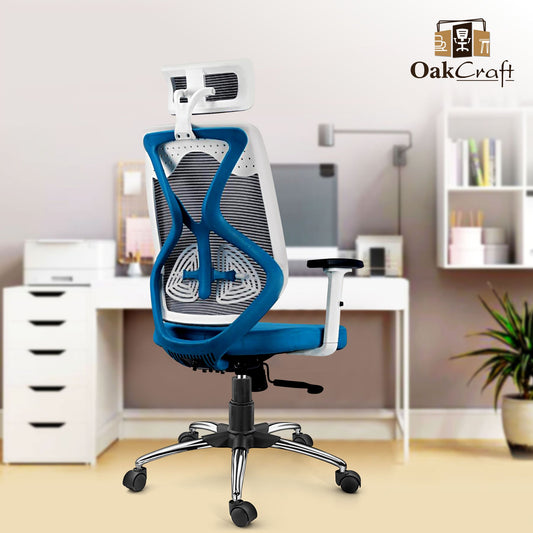
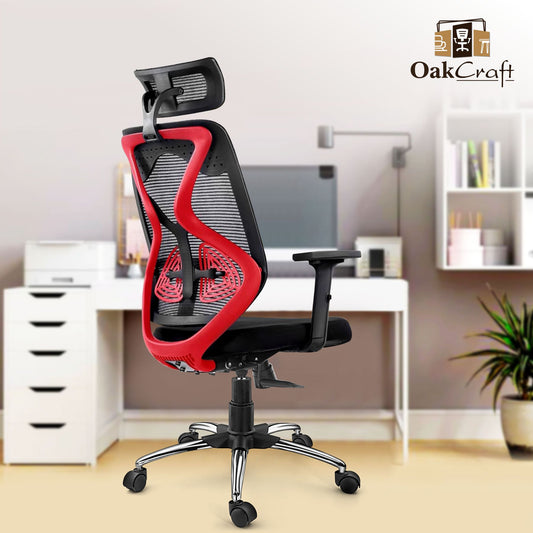
For full-time desk work → Oakcraft Matrix High Back Ergonomic Mesh Office Chair — breathable mesh back, high-back design with lumbar support, centre-tilt mechanism with lock.
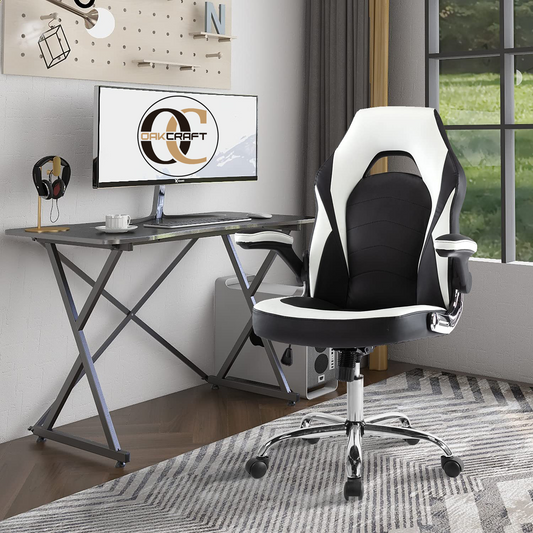
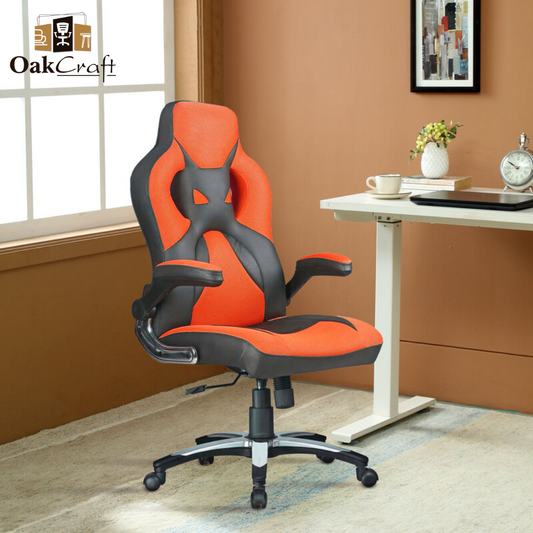
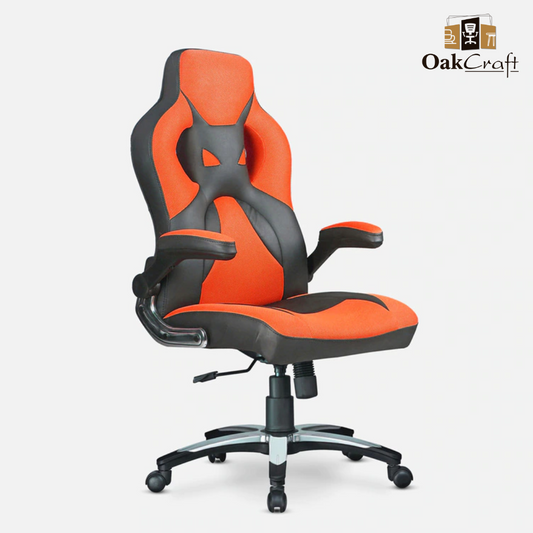
For gaming and mixed-use setups → Oakcraft Vigil High Back Leatherette Gaming Chair — from ₹8,400.
Bulk and institutional enquiries: contact@oakcraft.in or WhatsApp [NUMBER].

Frequently asked questions
How is an office chair manufactured? In eight stages: frame fabrication, foam moulding, upholstery cutting and sewing, backrest production, sourcing of bought-in components, sub-assembly, final assembly, and quality testing against a performance standard such as ANSI/BIFMA.
What materials are office chairs made from? Typically a steel or moulded plywood frame, polyurethane foam, mesh, fabric or leatherette upholstery, a nylon or metal base, a nitrogen gas cylinder for height adjustment, and a steel tilt mechanism.
Do office chair manufacturers make every part themselves? No. Gas cylinders, mechanisms, bases and casters come from specialist component producers, because each requires entirely different tooling. Manufacturers typically produce the frame, foam, upholstery and backrest in-house and specify the bought-in parts.
How long does it take to manufacture office chairs in bulk? Bulk manufacturing runs typically take 3–6 weeks depending on quantity and finish. Stock models can ship in days.
How do I tell if a company manufactures office chairs or just resells them? Ask what class the gas cylinder is, whether the foam is moulded or cut and at what density, and whether you can visit the factory. Manufacturers answer all three directly.
What is ANSI/BIFMA testing? The international performance standard for furniture. Seating tests include cyclic loading of seat and back, stability at the tipping point, drop tests, and caster durability — typically tens of thousands of cycles on a sample that is destroyed in the process.
About Oakcraft
Oakcraft manufactures office, gaming and institutional seating in Delhi and supplies businesses, institutions and government buyers across India as a registered seller on the Government e-Marketplace (GeM).